

When you head out for a few days of camping or backpacking, you carry only as much food as your pack can sensibly hold. Some of us prefer it that way. There is a quiet satisfaction in feeding yourself from the land instead of from a foil pouch. Depending on where you are, that might mean berries, wild fruit, fish, or small game. If you want the full picture on foraging, my guide on how to find food in the wild walks through the main food groups you can rely on.
Snails rarely make the shortlist, and that is a mistake. They are one of the most overlooked sources of energy out there: plentiful wherever there is greenery and moisture, slow enough that a child could gather a meal’s worth, and surprisingly nutritious. Snail meat is high in protein and iron, low in calories, and a solid source of magnesium, vitamin B12, and even omega-3 fatty acids.
In a genuine survival scenario, a handful of snails might be the difference between keeping your strength up and burning through your reserves while you wait to be rescued. And even when you are not in trouble, just camped out with time on your hands, they make for a novel meal and a skill worth practicing.
The catch is that you cannot simply scoop the first shell you see off a leaf and eat it. Some snails are far better eating than others, a few carry real health risks, and one or two are protected or invasive enough that you should think twice before touching them. So let’s go through which species are worth knowing, how to tell them apart, and most importantly, how to prepare them so they are safe.
See also: Is It Safe to Eat Scorpions? and Edible Snakes: Turning a Scaly Predator Into a Meal
Editorial note : This article was updated in August 2026
A Safety Note First, Please Don’t Skip This
I am putting this before the fun part on purpose, because the single most important thing in this entire article is this: never eat a wild snail raw or undercooked.
The most serious risk is a parasite called Angiostrongylus cantonensis, better known as rat lungworm. In humans it can cause eosinophilic meningitis, a nasty and occasionally life-threatening inflammation of the membranes around the brain. The parasite is most common in Southeast Asia, the tropical Pacific islands, and parts of the Caribbean, but cases have turned up in Hawaii, Brazil, Australia, and a growing list of other regions. The range is spreading, not shrinking.
Wild snails can also carry liver flukes and other trematodes depending on where you are. And because snails feed on soil, decaying matter, and whatever vegetation is around, they can accumulate heavy metals, pesticides, and other contaminants. A snail harvested next to a sprayed field or a roadside ditch is a worse bet than one from clean, damp woodland.
A few non-negotiable rules:
- Cook every snail thoroughly. A rolling boil for at least 8 minutes is the minimum (more on this below).
- Wash your hands after handling raw snails, and do not transfer their mucus to your mouth.
- Do not eat the slime raw, and rinse any produce a snail may have crawled across.
- When in doubt about the water or soil quality of an area, harvest somewhere cleaner.
Treat snails the way you would treat any wild protein, with respect for the fact that “free food” still comes with a preparation tax you cannot skip.
How to Recognize an Edible Snail
In the wild, most snails hide in damp, wet, or mossy spots. Finding them takes patience: they have plenty of natural predators such as hedgehogs, ground beetles, leeches, and birds, so they stay tucked away during the bright, busy hours when people tend to look for them.
The species below are the ones worth learning. I have grouped them roughly from “best eating and easiest to find” down to “only if you know what you are doing,” and I have flagged the few that come with conservation or safety asterisks.
Cornu aspersum (the garden snail)

Formerly Helix aspersa, and known in France as the petit gris (“little grey”), this is one of the two most widely farmed edible snails on the planet, which tells you something about how good it is to eat.
- Size: Adults run 25 to 40 mm across, with 4 to 5 whorls.
- Shell: Roughly spherical with a short spire and a slightly wrinkled surface; usually pale brown to yellow or cream with darker brown spiral banding.
- Where: Native to the Mediterranean and the Spanish coast, but now established across the US, Australia, New Zealand, and parts of Latin America. It adapts easily to new climates, which is exactly why it has spread so far and farms so readily.
- Habitat: Temperate forests, meadows, and farmland. It loves fruit trees, vegetables, and flowers, so gardens and orchard edges are prime hunting grounds.
If you only learn to identify one snail on this list, make it this one. It is common, sizeable, and genuinely tasty.
Helix pomatia (the Roman snail)

This is the classic escargot, the escargot de Bourgogne, the one French restaurants made famous. It is noticeably bigger than Cornu aspersum (around 45 mm across) and is widely considered the better-flavored of the two.
- Shell: Creamy or light brown with faint darker bands, and a white edge around the shell opening.
- The snail itself: Look for two pairs of tentacles on the head.
- Where: Native to Europe; happiest in lime-rich soil along bushes, hedges, and forest margins.
- When: It prefers cool, humid conditions and avoids direct sun, so early morning after rain is your best window. It has been found as high as 2,100 meters in the Alps.
A quick note on names: you will sometimes see Helix pomatia called the “apple snail,” but that label properly belongs to a completely different freshwater species (more on that at the end). Do not let the nicknames confuse your identification.
Otala lactea (the milk snail)

Also called the vineyard snail or Spanish snail, this one is distinctive once you have seen it.
- Size: Up to about 35 mm in diameter, with a noticeably depressed (flattened) shell.
- Shell: Reddish-brown spirals over a strongly patterned base of dots and stripes; the lip of the opening is a dark brown that is almost black. The shell’s navel (the small depression at the base) is visible.
- Habitat: Rocky or bushy heathland. It is nocturnal, so search after dark.
Iberus alonensis (the serrana), harvest sparingly

Known in Spain as the serrana, this snail has been part of the human diet since Roman times, and its decent size makes it appealing.
- Size: Around 30 mm, with roughly 4 whorls in a white-and-brown pattern and a distinctly flat profile.
- Habitat: Limestone country, under rocks and in the crevices of plants and shrubs.
One important caveat: Iberus alonensis is classified as near-threatened, largely because of overharvesting. I would identify it for interest’s sake but leave it alone in the wild, or take only what you genuinely need in a true emergency. There are plenty of more abundant species on this list.
Cepaea nemoralis (the grove snail) and Cepaea hortensis (the white-lipped snail)

These two close cousins are among the most recognizable small snails you will encounter.
Cepaea nemoralis, the grove or brown-lipped snail, is wonderfully variable: shells come in brown, orange, olive, or yellow, often with up to five dark spiral bands that can blur together. The giveaway is the dark brown lip of the shell in an adult. The body is greenish-grey, shading to yellow toward the foot. Originally Central European, it is now found across much of the US (California, Tennessee, Massachusetts and beyond) and Canada, in everything from woodlands to dunes.
Cepaea hortensis, the white-lipped snail, looks similar but has a white lip instead, and tends to be smaller, around 20 mm. It is native to Western Europe and now widespread in the US, where it favors tree trunks, full-canopy woodland, and shrubs. Honest assessment: it is small, and a lot of people find it does not taste like much. I would treat it as backup rather than a target.
Helix aperta (the green garden snail)
A handsome Mediterranean species that likes shrublands, fields, gardens, and woodlands.
- Shell: Olive-green to greenish-brown, semi-translucent, with no bands or stripes and a last whorl that is clearly larger than the rest. Around 22 to 28 mm with 4 rapidly-increasing whorls.
- Where: Native to France, Italy, and the wider Mediterranean; now established in places like California and Louisiana.
Theba pisana (the white garden snail)
In some parts of California this is treated as a serious garden pest. It can shred a vegetable patch fast, which from a forager’s point of view means free food.
- Shell: Opaque, tough, and slightly flattened; ivory-yellow with uneven brown banding that is sometimes broken into dots and dashes.
Helix lucorum (the Turkish snail)
Found around Turkey, the Balkans, and the Black Sea region.
- Size: A good 35 to 60 mm across and 25 to 45 mm tall.
- Shell: Pale, much like the Roman snail, but with larger, rounder whorls and broad brown bands that seem to melt together over the lighter base color.
- When: Hunt at night, ideally after rain.
Eobania vermiculata (the chocolate-band snail)
Originally Mediterranean, now found in Louisiana and Texas. The name comes from the dark “chocolate” rings that follow the whorls. A perfectly good edible species where it is abundant.
Otala punctata (the Spanish snail)
Closely resembles the milk snail (Otala lactea) but with a less strongly colored shell opening. You will typically find it in coastal agricultural areas: the Balearic Islands, northwest Algeria, the Costa Blanca.
Sphincterochila candidissima
Sometimes listed as Leucochroa candidissima, and known locally as cargol mongeta or cargol jueu. At around 20 mm it is small, but it is unmistakable: stark white shells over very dark bodies. Mostly found in Italy.
Two Big Ones to Approach With Caution
Lissachatina fulica (formerly Achatina fulica)
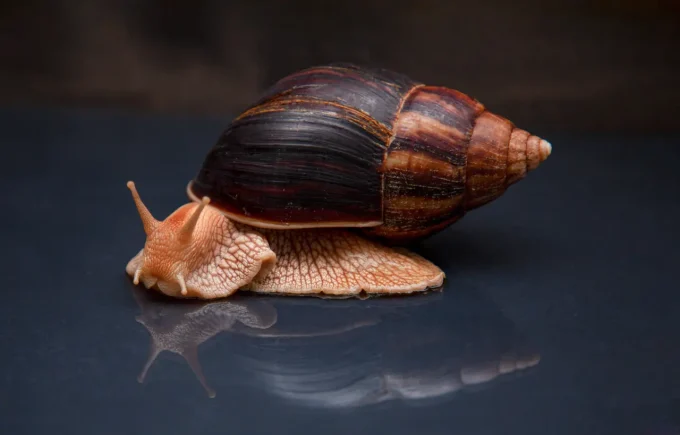
Also known as the giant African snails, they can grow up to 326 mm or 1’ 3/4” in length. There are efforts to eradicate this species due to the damage and fecal material they create.
The USDA has banned the possession and importation of this species in the US, classifying it as a serious agricultural pest. More importantly, this species is known as an intermediate host for zoonotic parasites (aka the worms I talked about in the intro).
However, their large size makes them an ideal meal if you’re really hungry, and can be found in almost every country of the world. If you find one outside of a controlled farming environment, be cautious regardless of how hungry you are. Proper, thorough cooking is not optional with this one.
Pomacea canaliculata (Apple Snail)
Not a European species, but worth knowing if you are anywhere in Southeast Asia or South America. Native to South America, this freshwater snail is eaten extensively across Asia and has become one of the most widely consumed edible snail species in the world.
It is also highly invasive in many regions where it has been introduced. You will typically find it near rivers, canals, and rice paddies.
The shell is usually bright golden-yellow or dark brown and considerably larger than most land snails you would encounter in Europe or North America. The same preparation and safety rules that apply to land snails apply here, and thorough cooking is just as important.
Why Bother? The Nutritional Case for Snails
When you are miles from the nearest town and rationing what is in your pack, the math of wild food matters. Here is what snails bring to the table.
Protein, and plenty of it. Unless you drown them in butter, snails are low-calorie and high-protein, and they actually out-protein most seafood, at roughly 16%. That protein is exactly what your body needs to repair the muscle you tax on a long day of hiking.
Iron. Iron moves oxygen and energy around your body, and running low leaves you fatigued, a dangerous state when help is far away. Around 100 grams of snail meat covers roughly 19% of your daily iron needs.
Vitamin B12. Often called the “energy vitamin,” B12 helps your body release energy from food, process folic acid, and make red blood cells. Snails are a reliable source, which helps stave off early exhaustion.
Magnesium. Important for blood pressure regulation, stress management, and overall function. About 100 grams of snails delivers a substantial share of your daily magnesium.
Selenium. You do not need much, but it keeps your immune system healthy and helps protect cells from damage, handy for staying well while you are roughing it.
Omega-3 fatty acids. Good for the heart and joints, and snails carry higher levels than a lot of seafood. The joint benefit is a quiet bonus if you have been overexerting yourself on the trail.
For the bigger picture on stretching limited resources in an emergency, my guide on how to survive in the wild with nothing puts food into the wider context of shelter, water, and rescue.
How to Find Snails in the Wild

Snails reward patience and the right timing more than effort.
Hunt at the right hour. Most snails are nocturnal. They dry out in heat, so they feed when it is dark and damp. Your best luck is at night, or early in the morning, and especially after heavy rainfall.
Search the right habitats. Because they avoid sunlight, look in damp, dark, or shaded spots: under rocks and forest debris, beneath planks or fallen wood, and in damp weedy patches. Where there is little shade, some species burrow to stay cool, so it is worth turning over likely cover.
Follow the slime trails. If you are struggling to spot the snails themselves, look for the silvery trails they leave on dry surfaces: rocks, dirt, tree trunks, and other vertical surfaces. Trace them and they will often lead you to the snail.
Lure them if you have to. If a quick scan does not turn up enough, you can encourage them out:
- Identify a likely snail habitat.
- In the late afternoon or early evening, dampen the area with water.
- Return after dark and follow the fresh slime trails to your catch.
How to Prepare and Cook Snails
Out in the field your options are more limited than at home, but the core process does not change. Follow every step, and given the safety section above, do not skip the cooking stage under any circumstances.
Step 1: Collect and store
Bring a glass or wooden container and punch a couple of air holes in the lid so the snails can breathe. They are best eaten alive and active, so keep them that way until just before cooking. A breathable container in a cool, shaded spot will hold them in good condition.
Step 2: Purge (the step most people skip, do not)
Purge your snails for at least 48 hours before eating. This empties their digestive system so you are not consuming grit, droppings, or whatever they last ate off the ground. Give them no food or water during this period. If you have the time and resources beforehand, you can feed them lettuce or fruit for a day or two to fatten them up and flush out anything questionable from their previous diet.
Step 3: Clean
Remove the membrane covering the shell opening. Soak the shells in enough water to cover them for about 4 hours, adding either half a cup of salt or a quarter cup of vinegar for every 50 snails. The mucus will cloud the water white, so change it several times during the soak and rinse repeatedly until no mucus remains.
Step 4: Cook (the critical step)
Put the snails in cold water, bring it to a boil, and cook at a rolling boil for at least 8 minutes to kill any parasites. Eight minutes is the floor, not the target. In a survival context, where you have no idea where that snail has been, I would not go a second under. Drain, then plunge them into cold water.
Step 5: Extract the meat
Use a needle or small fork to pull each snail from its shell. Remove the intestines and cut away all the black parts. Many people also remove the head, tail, and the cartilage-like gristle. What is left is the meat, ready to be seasoned and finished however your situation allows: sautéed in a little fat and garlic if you are lucky, or simply eaten as-is if you are not.
A Few Closing Thoughts
Snails are a pest or a protein source depending entirely on your point of view. Gathered on a camping or backpacking trip, they add variety to your meals and a genuinely useful skill to your kit, and in an emergency, they can deliver energy exactly when you need it most. They are widespread, slow, and packed with nutrition, which makes them about as reliable a wild food as you will find while you wait for rescue.
The best way to get comfortable is to practice before you ever need to. Spend an afternoon identifying the snails in your own garden and comparing them with what you find on the trail, until telling an edible Cornu aspersum from its lookalikes becomes second nature. That kind of familiarity is what turns “I think this one is safe” into “I know this one is safe,” and that confidence is worth a lot when it counts.
A couple of things worth packing while you are at it. A good blade makes field-dressing and food prep far easier, so it is worth reading up on the best Bowie knives and the best all-round survival knives before your trip. And since you will be lingering in exactly the damp, shaded spots that mosquitoes love, a batch of homemade insect repellent will save you a lot of misery.
So, are snails making it onto your camp menu this season? Tried a species I have not mentioned, or got a prep trick of your own? Tell me about it in the comments below.

Mark Foster loves to push his limits when it comes to survival in the wilderness. He might go for a 30-days adventure without any food or equipment except for a survival kit and a knife. We should mention that his survival kit has 122 items in it, so he know what he is doing. Mark is working on his book to share with the world all his experience gained during those brave adventures.
Wow! This is very interesting. I have never tried snails but this really made me curious. I have seen them as pests before to be completely honest. It is nice too that you included a step-by-step guide on how to prepare it for consumption. Kudos for another great article Mark.
Thank you, friend!
I have always loved camping adventures and part of it is looking for fresh food like fruits though I have never tried any snail dish. I will take note of your tips just in case I will need them next time. Great thing you mentioned about purging the snails before consuming them. Will this affect its taste?
Yes