
To choose a stand-up paddle board as a beginner, pick a wide (31 inches or more), medium-length (9 to 12 feet) board with a flat planing hull and high volume for your weight, since that combination gives the stability new paddlers need. An all-around inflatable or EPS-foam board with a removable fin suits most beginners for calm lakes and gentle surf, while narrower displacement boards are for touring and racing later on. Match the board to your weight, your water, and how you’ll transport and store it.
Many people assume paddle boarding is just like surfing, but it’s quite different, and it makes a great stepping stone into surfing for beginners. Stand-up paddle boarding, or SUP, uses a paddle to move across open water, which is handy when there are no waves to carry you. Like surfing, though, choosing the right board matters, and this beginner’s guide covers everything you need to know to get it right the first time.
What Kind of Paddle Boarding Will You Do?
You can’t just grab the first board you see, since boards are built for different styles of paddling. Start by deciding how you’ll use it.
All-around and recreation. If you want fun, fitness, and a bit of everything, choose an all-around board built for stability and easy maneuvering. Speed isn’t the priority, though you’ll still get a decent glide. This is where almost every beginner should start, and it’s the most popular category by far. For specific models, see our picks for the best SUP paddle boards for beginners.
Touring and racing. These boards are built for covering long distances at higher speeds, so they prioritize efficiency and glide over stability. They’re a better fit once you’ve built confidence and know you want to go faster and further.
What makes a board suit one style over another comes down to its hull type, volume, length, width, materials, and fins. Here’s how each of those works.
Paddle Board Hull Types
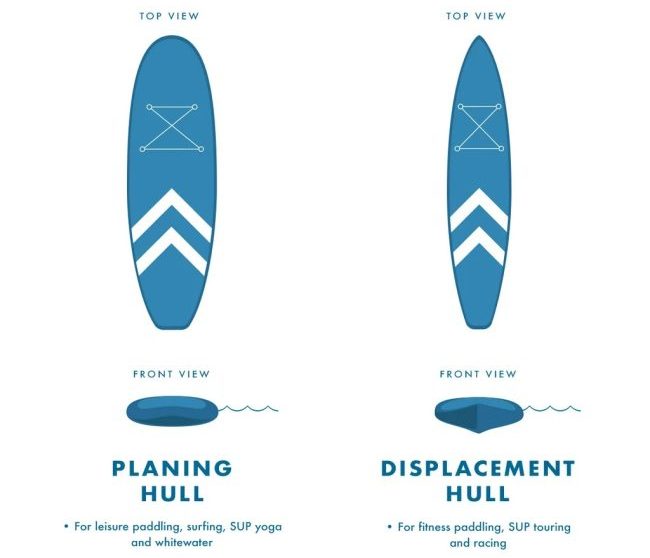
The hull is the body of the board, and its shape decides how the board behaves in the water. There are two main types.
Planing hull. Flat and wide, similar to a surfboard, a planing hull rides on top of the water. It’s stable, forgiving, and good for surfing small waves and general paddling, which makes it the best choice for beginners.
Displacement hull. Narrow with a pointed nose like a kayak or canoe, a displacement hull slices through the water and pushes it around the nose for a faster, more efficient glide. The trade-off is stability, since the narrower shape tips more easily, so these suit experienced paddlers, tourers, and racers.
Volume and Weight Capacity
There’s no one-size-fits-all paddle board, because the right board has to float you properly. Two numbers tell you whether a board suits your body.
Volume is measured in liters and tells you how much the board will float. A higher volume supports more weight and feels more stable, so heavier paddlers need more volume to stay high on the water.
Weight capacity is listed in pounds and is the maximum load the board can carry before it sits too low and becomes sluggish and hard to paddle. Always check this figure and leave some margin for gear, since exceeding it ruins the experience. If you’re near the top of a board’s range, size up to the next board.
Length and Width
Your board’s dimensions should match your intended use, and they also affect how easily you can transport and store it. A full-size board won’t fit in a closet, so think about your car and storage space before buying.
Paddle boards come in three length ranges.
- Short boards (under 9 feet) are made for surfing. They’re maneuverable and stable in waves. Boards around 8 feet suit children.
- Medium boards (9 to 12 feet) are the all-around sweet spot, handling surf, flatwater, and even casual racing. They’re ideal on calm lakes and the best choice for most beginners.
- Long boards (12.5 to 14 feet) are built for touring and racing. They’re faster and track straighter, but they’re less maneuverable.
Width works the same way. Wider boards of 31 inches or more are far more stable but slower, while narrow boards of 29 to 30 inches are faster but tip more easily. For beginners, the best combination is a wide board in a short-to-medium length. Don’t go too wide, though, since a board wider than your comfortable reach makes paddling awkward and tiring. If you can, try a few widths before buying.
Paddle Board Materials
Boards are made from different materials to balance weight, durability, and stability. Knowing the construction tells you how a board will perform.
EPS foam. A foam core wrapped in fiberglass and epoxy, sometimes with carbon fiber or plastic on the exterior. This is the most common hard-board construction and offers a good balance of weight, stiffness, and versatility.
Hollow core. A lighter construction that reduces weight for more speed, popular on performance boards.
Polyurethane foam. Heavier than EPS, which adds stability, so it’s sometimes used on entry-level boards.
Inflatable (iSUP). Made from drop-stitch PVC with an air core, inflatables are durable, easy to carry, and pack down small for storage and travel, making them perfect for beginners and casual paddlers. You’ll need a SUP pump to inflate one, and most inflatable packages include one.
Understanding Paddle Board Fins
Like surfboards, paddle boards use fins underneath to add tracking (how straight the board holds its line) and stability. Several setups exist.
- Single large fin. Slots into a fin box and is held with a nut and screw. The fin box lets you slide the fin forward or back to tune tracking. Some boards include one, others need it added.
- Three-fin (thruster). One larger center fin with two smaller side fins in a triangle. This gives straight tracking plus good control for surfing.
- Race fins. Stiff fins designed to hold a line against strong wind and current, made for long touring and racing boards.
- Inflatable fins. Flexible rubber or semi-rigid plastic fins that attach to inflatable boards for better tracking.
You can paddle without a fin, but it hurts tracking and stability, so beginners should always use one for the extra control and safety.
Shape and Other Features
Beyond the hull, a few shape details affect how a board rides.
Nose shape. A wide nose adds flotation and makes it easier to catch waves, while a narrow nose cuts through chop and suits touring and racing boards.
Tail shape. A rounded or pin tail adds stability on bigger waves and smoother turns, while a square or angular tail makes handling looser and snappier for sharp turns. Choose based on how you’ll ride.
Bottom contour. Besides planing and displacement shapes, a concave bottom channels water along the board for extra lift and less drag as you move.
Rails. The edges of the board. Thicker rails add stability on family and all-around boards, while race boards use varied rail shapes for performance. If racing interests you, ask an experienced paddler or a knowledgeable shop assistant.
Essential Paddle Boarding Gear and Safety
Once you have your board, a few accessories make paddling safer and more enjoyable.
Paddle. The most important accessory, since without it you’re just standing still. As a rough rule, an all-around SUP paddle should reach about 6 to 10 inches above your height, a little shorter for surfing and a little taller for racing. A good adjustable SUP paddle lets you fine-tune the length.
Personal flotation device (PFD). The US Coast Guard classifies paddle boards as vessels when used outside a designated swimming or surfing area, so you must carry a Coast Guard-approved PFD on board. Many states require you to wear it, and children almost always must, so check your local rules. Wearing one is the safest choice no matter how strong a swimmer you are.
Whistle and light. If you paddle after sunset, you’re required to carry a sound-signaling device like a whistle and a white light to signal your position.
Clothing. Dress for the water temperature, not just the air. In cool conditions a wetsuit helps prevent hypothermia if you fall in, since a wet body loses heat fast. In warm weather, wear anything comfortable that won’t restrict movement when wet.
Leash. Usually sold separately, a SUP leash tethers the board to you so it doesn’t float away if you fall off. It’s a key safety item, since your board is also your biggest flotation device.
Car rack. To carry a hard board you’ll need a SUP roof rack that fits your car’s crossbars. Check the manufacturer’s fit specs for your vehicle. This is one more reason many beginners choose an inflatable.
Traction pad. The grippy foam deck pad that keeps you planted on the board. Most boards include one, but you can add a traction pad if yours doesn’t.
Frequently Asked Questions
What size paddle board should a beginner get?
Most beginners should choose an all-around board that is 10 to 11 feet long and at least 32 to 34 inches wide, with enough volume for their body weight. That width and length give the stability new paddlers need while still being easy to maneuver on calm water and small waves.
Are inflatable or hard paddle boards better for beginners?
Inflatable boards are usually better for beginners because they’re stable, durable, forgiving in a fall, and pack down small for easy transport and storage. Hard EPS boards are stiffer and faster, which experienced paddlers often prefer, but they need roof racks and more storage space.
What size SUP paddle do I need?
An all-around SUP paddle should reach roughly 6 to 10 inches above your height. Go a little shorter for surfing, where a lower paddle helps with quick strokes, and a little taller for racing and touring, where a higher paddle improves reach and power. An adjustable paddle lets you dial it in.
Do you legally need a life jacket on a paddle board?
Yes, in most cases. The US Coast Guard treats paddle boards as vessels outside swimming and surfing zones, so you must carry a Coast Guard-approved PFD. Many states require you to wear it, and children usually must, so check your local regulations before heading out.
How much weight can a paddle board hold?
It depends on the board’s listed weight capacity, which typically ranges from about 200 to 350 pounds for recreational boards. Stay comfortably under that limit and account for any gear you carry, since an overloaded board sits low in the water and becomes slow and unstable.
Is stand-up paddle boarding hard for beginners?
Not with the right board. On a wide, stable all-around board in calm water, most people stand and paddle within their first session. Starting on your knees, keeping your gaze on the horizon, and choosing flat water on a calm day all make learning faster and easier.
Conclusion
If all of this feels like a lot, the best move is to try before you buy. Paddle boarding doesn’t need much gear, but it’s still an investment, so there’s no sense starting with the wrong board. Rent a few different boards first to get a feel for what suits you, and the rental staff can often offer helpful tips for your eventual purchase.
For beginners, a wide all-around board with a planing hull, plenty of volume, and a removable fin is the safest, most enjoyable place to start. For related gear advice, read our guide on how to choose the best canoe paddle size. Already paddling? Share your own beginner tips in the comments below.


If price is not an issue, what board would you recommend? I’m looking for a board for a beginner – me! – but I don’t think I want an inflatable one. Happy to be persuaded otherwise though… I’d mainly be using it on a lake rather than at the beach though, I guess, there’s a chance I’ll get out to the beach a few times a year. What’s the deal with bamboo boards? I see you didn’t mention anything about them. Would you not recommend a bamboo SUP?
The key when buying a SUP – as with anything – is to really do your research. I went with the Red Paddle Co 12’6’’ Race. I’ve been paddleboarding for a few years but now I’m looking to get into the race scene. I researched thoroughly and found this to be in my budget and perfect for my needs. It can be inflated to 25psi which is the highest on the market, as far as I’m aware, which seems to help it reach very high speeds. Know what your budget is and what you want from a SUP and go from there!
Inflatables are take the worry out of the board being dented or scratched. It’s more compact, too- you can take it anywhere! For beginners, inflatables are easier to use. If you’re not going for some serious surfing on the waves, inflatables are best. They are also inexpensive.
Some people (usually newbies) think inflatables are like those kids’ playthings. They’re mistaken. These paddleboards are made from excellent materials – they’re not kidstuff, that’s for sure.