
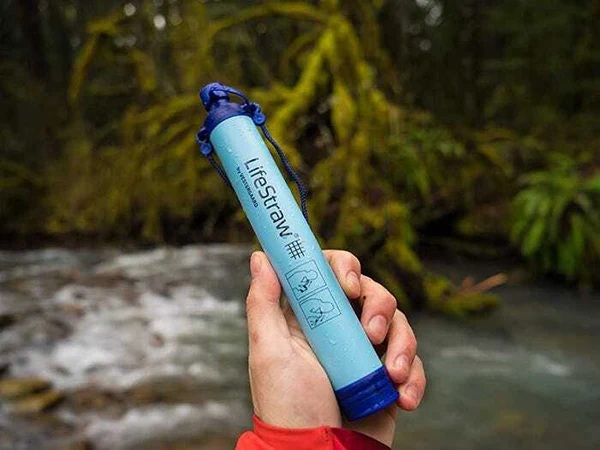
The LifeStraw Personal Water Filter is a lightweight, award-winning straw-style filter that removes bacteria, parasites, and microplastics from contaminated water using a 0.2-micron hollow-fiber membrane, with no chemicals, batteries, or pumping required. It filters up to 4,000 liters, weighs under two ounces, and is an excellent emergency and backpacking tool. The one thing to know is that it does not remove viruses, dissolved chemicals, or salt, so it’s best for North American and most backcountry water rather than virus-prone water in some developing regions.
Note: We get commissions for purchases made through links in this article, at no extra cost to you.
We all need water to survive, but what we don’t always know is whether the water in front of us is clean and safe. It’s a problem much of the world lives with daily, and it’s one you face the moment you step onto a trail. Filtering your water while hiking, camping, or backpacking isn’t optional, it’s essential, and plenty of products promise to do it, though some are far better than others.
Of all the gear you carry into the wild, a reliable water filter is arguably the most important single item. The LifeStraw Personal Water Filter has been a benchmark in this space for years. Any natural water source can hold thousands of microscopic organisms you can’t see, and while most tap water contains some harmless ones, wild water can carry organisms that make you seriously ill.
Learning what might be in your water, and where it comes from, is the first step to staying safe. We take clean drinking fountains and taps for granted, but that’s a luxury we leave behind on the trail, and clean water should never be the convenience you go without.
LifeStraw Personal Water Filter: Specifications
- Award-winning design used by millions worldwide since 2005
- Removes at least 99.999999% of bacteria (including E. coli, salmonella, and cholera)
- Removes at least 99.999% of parasites (including Giardia and Cryptosporidium)
- Removes at least 99.999% of microplastics, plus sand, dirt, and cloudiness
- Filters up to 4,000 liters (about 1,000 gallons) of water, enough for years of personal use
- Uses no iodine, chlorine, other chemicals, or batteries
- Comes sealed, making it ideal for emergency and go-bag storage
 The Technical Details
- Length: about 8.8 inches
- Width: about 1 inch
- Weight: roughly 2 ounces
- Filtration: 0.2-micron hollow-fiber membrane (microfiltration), with durable plastic housing to resist cracking
- Filter life: up to 4,000 liters before replacement
- Best for: hiking, camping, backpacking, hunting, fishing, travel, and emergency kits
Important: What the LifeStraw Does Not Remove
This is the single most important thing to understand before relying on one. The Personal filter’s 0.2-micron membrane is excellent against bacteria and parasites, but viruses are far smaller than 0.2 microns, so this filter does not remove them. It also does not remove dissolved chemicals, heavy metals, or salt, and it cannot desalinate seawater.
In practice, that makes the LifeStraw Personal a great choice for backcountry water in North America, Europe, Australia, and similar regions, where bacteria and protozoa are the main threats and waterborne viruses are rare. If you’re traveling somewhere with a real risk of waterborne viruses, such as some developing regions with heavy human-waste contamination, you need a purifier rated to remove viruses, not a microfilter. I’ll point you to the right LifeStraw models for that below.
Who Should Use the LifeStraw?
The LifeStraw Personal is ideal for anyone traveling where clean water may not be guaranteed, including hikers, campers, cyclists, hunters, and anglers, as well as travelers in places where tap water isn’t reliably safe (keeping the virus limitation above in mind). Its biggest practical benefit is that it frees you from carrying large volumes of water, which is heavy. You should always set out with an adequate daily supply, but with a LifeStraw you can safely top up from almost any freshwater source you find along the way.
How Does the LifeStraw Work?
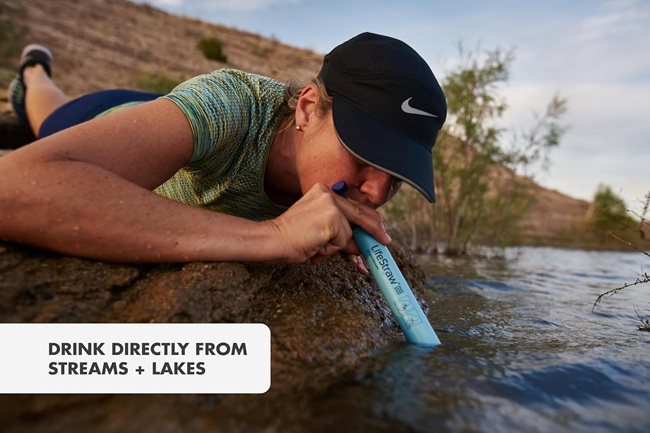
The LifeStraw’s genius is its simplicity. It works exactly like a drinking straw, with nothing to connect, screw together, pump, or charge, and no chemicals to measure or wait on. You either drop it into a bottle of contaminated water or drink directly from the source on the ground.
To use it, remove the bottom cap and place that end into the water. Open the top cap, put your mouth on it, and sip. After three to five seconds of drawing water up, you’ll be drinking clean, filtered water. That’s the entire process. As you drink, untreated water is pulled through the hollow-fiber membrane, which traps bacteria, parasites, and microplastics while clean water passes through to you.
What Owners Love About It
The LifeStraw has a large base of satisfied users, and their praise tends to center on a few things. At under two ounces, it’s light enough to hang around your neck or clip to a pack without a second thought. Because there are no separate parts, there’s nothing to lose or assemble, which keeps things fast and foolproof when you’re tired and thirsty.
Maintenance is refreshingly low. The easiest way to clean it in the field is to backwash it. After each drinking session, blow air back through the mouthpiece to push the dirty water back out through the bottom. This flushes the membrane, stops debris and bacteria from sitting inside the straw between uses, and keeps it performing well for the next drink.
A few cautions come up often from experienced users. The plastic body gets slippery when wet, so keep a firm grip and never drop it in a way that could crack it. Never let the clean mouthpiece end touch dirty, unfiltered water, and don’t leave the straw sitting inside a bottle of contaminated water, since untreated water could enter through the wrong end. Don’t set it down on the ground or other surfaces that might carry bacteria either.
One more point worth knowing is that the Personal filter is built for one person. If you’re traveling with family or friends, a gravity filter that treats larger volumes may serve you better. That said, many groups find it convenient for each person to carry their own straw, so nobody waits around for water.
Pros and Cons of the LifeStraw Personal
Pros
- Very lightweight at under two ounces
- No separate parts, chemicals, or batteries needed
- Removes 99.999999% of bacteria and 99.999% of parasites and microplastics
- Simple and genuinely foolproof to use
- Reusable for up to 4,000 liters over its life
- Easy to clean by backwashing
- Fits most standard water bottles
Cons
- Does not remove viruses, dissolved chemicals, heavy metals, or salt
- Filters only small volumes at a time, so it’s poor for cooking or group water
- Built for a single person
- Slippery plastic body that’s easy to drop
- Can be ruined if the clean end is submerged in contaminated water
- Must not be allowed to freeze with water inside, as freezing can damage the membrane
LifeStraw Family Lineup: Other Models to Consider
The LifeStraw name covers several products, and they don’t all work the same way, so here’s how they differ.
LifeStraw Steel
The LifeStraw Steel is much like the standard straw but wrapped in a more durable stainless steel body and cap that better resists cracking. It also adds a replaceable activated carbon capsule that reduces chlorine, bad tastes, and odors, which the basic model does not do. The core membrane still targets bacteria and parasites, not viruses. Check the LifeStraw Steel on Amazon.
LifeStraw Go
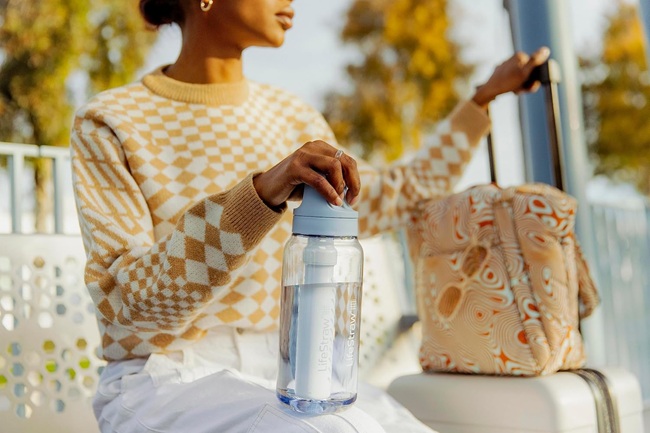
The LifeStraw Go is the trusted LifeStraw membrane built into a refillable water bottle, so you don’t need to bring a separate bottle. Fill it from a source, slide the filter back in, tighten the lid, and drink. Many versions also include an activated carbon stage for taste. It’s convenient, though cleaning and backwashing are a little more involved than with the bare straw. Check the LifeStraw Go on Amazon.
LifeStraw Family
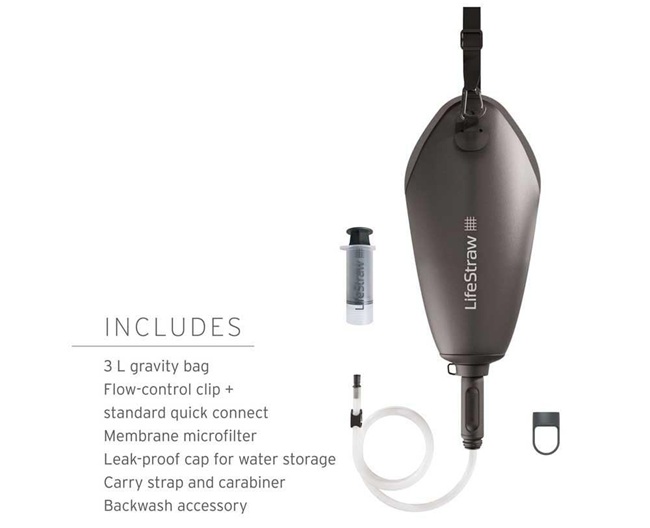
The LifeStraw Family is a gravity-fed filter: fill the top reservoir with dirty water and let gravity pull it through into a clean tube and tap. Crucially, the Family and Mission units use a finer 0.02-micron ultrafiltration membrane that also removes viruses, which the personal straw cannot do, making them a better fit for higher-risk water and for families. It’s designed to supply a household for years before replacement. The main drawback is needing a sturdy, high point to hang it from, which can be tricky where trees are scarce. Check the LifeStraw Family on Amazon.
LifeStraw Mission (5 or 12 Liter)
The LifeStraw Mission is a larger gravity-fed filter, ideal for groups of more than five. You fill the bladder from the nearest source, hang it high, and let gravity do the rest, then drink from the tap or fill bottles using the lever. Like the Family, it uses virus-removing ultrafiltration, and it’s great for clean cooking water too. It comes in five- and twelve-liter sizes that roll up small for storage. Check the LifeStraw Mission on Amazon.
Why Water Filters Matter: The Threats in Wild Water
Untreated water can carry organisms that cause serious illness. Three of the better-known culprits are guinea worm, cryptosporidiosis (Crypto), and giardiasis. None of these are viruses. Guinea worm is a parasitic worm, while Crypto and Giardia are protozoan parasites, and a quality microfilter like the LifeStraw is designed specifically to remove parasites like these.
What is Guinea Worm
Guinea worm disease comes from swallowing water that contains tiny water fleas carrying guinea worm larvae. Once inside the body, the larvae mature, and about a year later an adult worm slowly emerges through a painful blister in the skin, usually on the lower leg. When that blister contacts water, the worm releases new larvae, continuing the cycle. Symptoms before emergence are often minimal, but can include fever, an itchy rash, nausea, vomiting, and diarrhea. It’s worth noting that guinea worm has been driven to the brink of eradication through decades of public-health work and now occurs in only a tiny number of places, so it’s rarely a practical concern for most travelers, though it illustrates why filtering matters.
Cryptosporidiosis (Crypto)
Crypto is a parasite found in the feces of infected animals and people, and it can contaminate water, soil, food, and surfaces. You can pick it up by swallowing contaminated water while drinking, wading, or swimming. The most common symptom is watery diarrhea, typically starting two to ten days after exposure, along with stomach cramps, dehydration, nausea, vomiting, fever, and weight loss. Symptoms can last a few weeks, and Crypto is notoriously tough because its hardy shell resists chlorine, which is exactly why filtration and boiling matter.
Giardiasis
Giardiasis is similar to Crypto and also spreads through fecal contamination of water and food. Giardia protects itself inside a hardened cyst, which lets it survive outside a host and shrug off chlorine disinfection, so chemical drops alone are unreliable against it. It causes watery diarrhea, cramps, gas, and fatigue, and it’s one of the most common waterborne parasitic infections in the United States. A 0.2-micron filter physically removes Giardia cysts, which is the most dependable defense alongside boiling.
What Makes a Great Water Filter
When comparing water purification systems, a few qualities matter most.
Size and Weight
The LifeStraw is among the smallest and lightest options available, which counts for a lot when every ounce in your pack matters. Larger systems with pumps, levers, or bladders can move more water, but they add bulk, weight, and setup time. Match the tool to the trip.
Product Life and Durability
A filter is a survival item, so longevity matters. You want something durable, easy to clean in the field, and low-maintenance between trips, ideally reusable for thousands of liters. Spending more doesn’t automatically buy longer life, so compare real filter capacities and read owner experiences before you choose.
The Filtration Method
There are four common ways to treat water, each with trade-offs.
- Chemical treatment: chlorine or iodine tablets and drops are cheap and packable, but can take 30 minutes or more to work, and dosing them wrong can make you ill. They’re also unreliable against Crypto.
- Ultraviolet (UV) light: kills many pathogens with light, but the water must be clear for it to work, and it needs batteries or charging.
- Absorptive media (like activated carbon): great at improving taste and capturing certain impurities, but it loses potency over time and isn’t a complete pathogen solution on its own.
- Microfiltration: the method the LifeStraw uses, physically straining out bacteria and parasites through a fine membrane. It’s fast, chemical-free, and highly effective against bacteria and protozoa, with the key limitation that standard microfilters don’t catch viruses.
Convenience
Ultimately, the best filter is one you’ll actually carry and use. Ask whether it’s light enough, simple enough, and reliable enough for a bad moment, when your bottles are empty and the only water around is a thin, murky trickle. That’s exactly the scenario the LifeStraw was built for.
Frequently Asked Questions
Does the LifeStraw remove viruses?
No. The standard LifeStraw Personal uses a 0.2-micron microfilter that removes bacteria and parasites but not viruses, which are smaller. For virus protection, use a purifier rated for it, such as the ultrafiltration-based LifeStraw Family or Mission, or a dedicated purifier.
How much water can a LifeStraw filter?
The LifeStraw Personal filters up to 4,000 liters (about 1,000 gallons) before it needs replacing, which is years of regular personal use for most people. When it reaches the end of its life, water simply stops passing through.
Can the LifeStraw make seawater safe to drink?
No. It does not remove salt or dissolved chemicals, so it cannot desalinate seawater. Making seawater drinkable requires distillation or reverse-osmosis desalination, not a microfilter.
Does the LifeStraw expire?
The filter itself has no shelf life when kept dry and unused, which is why it’s popular for emergency kits. Its working life is measured by the volume of water filtered, up to 4,000 liters, not by a calendar date.
How do you clean a LifeStraw?
Backwash it after each use by blowing air back through the mouthpiece to flush dirty water out the bottom. Let it air dry before storing, and never let it freeze with water inside, since that can damage the membrane.
Is the LifeStraw good for international travel?
It’s useful in many places, but remember it does not remove viruses. In regions where waterborne viruses are a real risk, choose a LifeStraw purifier or another virus-rated system instead of the basic Personal straw.
Final Verdict: Drink Up the Views, Not the Viruses
Water purification is no joke, and after this review you should have a clear picture of why a good filter matters, what to look for, and where the LifeStraw Personal fits. It’s compact, scientifically proven, and effective against the bacteria and parasites that cause most backcountry illness, all in a package that weighs under two ounces and costs very little. Its honest limitation is viruses, chemicals, and salt, so match it to the right water and, for virus-prone sources, step up to a purifier.
LifeStraw Personal Water Filter rating: 4.8 out of 5. Every backpacker knows the quiet dread of being unprepared, and while a forgotten jacket is a minor annoyance, going without safe water is not. The LifeStraw fits almost anywhere, works for hikers and travelers of nearly any age, and earns its place in a pack or an emergency kit. Being proactive here saves you time, money, and potentially a miserable bout of a waterborne illness.
Have you used a LifeStraw or another water filter on the trail? How did it compare? Share your experience in the comments below, and pass this article along so your friends never head into the woods unprepared.

Daniel is a gear freak when it comes to hiking, climbing and camping. He went to REI Outdoor School to meet new people and learn best practices. Don’t even try to argue with him about the latest backpack or ice axe, he tried most of them. Daniel’s dream is to climb Mount Everest.
Whilst I do think the LifeStraw is a very innovative product, I don’t think it would be any use to me. Quite often when hiking I’m not around a source of water for long periods of time, hence why I carry my water with me. I’ve no doubt that this would be extremely useful in a survival situation or in Third World countries, for example, but simply for hiking I don’t think it’s for me. I’ve never seen the Lifestraw Go option before, though that looks like it’d be much better suited to my needs. Might give that a try!
When you’re hiking for days and have plans of staying outdoors for long stretches of time, it’s impractical to be carrying a ton of water with you. You’ve got to look for sources of water and a LifeStraw is just the thing you need to make the water safe and potable.
I’d agree with Daniel: it’s sometimes not feasible to carry the amount of water that I’d drink with me at all times. This is where the Life Straw comes in! I’m able to drink at every water source that I pass and so I’m still drinking as much as I normally would without the extra weight. The only – very slight – issue I’ve had with the straw is that it takes a fair bit of suction to initially start sucking the water up and to keep it flowing. I’ve used it so much though that I’m now just used to it.
Hi there Richard! I’ve been a LifeStraw user for many years and it’s one of the best brand around. It is an innovative product and I’m pleased that you chose it for your needs. As I’ve said before, there are a lot of water-borne diseases around. With the high price of health care, prevention is still key to remain robust.