
Note: We get commissions for purchases made through links in this article.
The best backpacking water filters let you drink safely from almost any stream, lake or spring, so you never have to haul days of water on your back. I learned why that matters the hard way. Years ago, on a three-day trip, I drank from a clear alpine stream I was sure was fine. About a week later I found out it wasn’t. Giardia doesn’t care how pretty the water looks.
Streams can look crystal clear and still carry bacteria and protozoa that will end a trip fast, or follow you home and ruin the week after it. A reliable filter fixes that. It saves weight, saves money and gives you real peace of mind at every water source.
Filtration has also become lighter, faster and cheaper. After years of filtering everything from desert seeps to silty river crossings, these are the eight water treatment options I’d trust on the trail in 2026, sorted by who each one suits best.
Quick Picks: The Best Backpacking Water Filters
- Best Overall: Sawyer Squeeze
- Best for Fast Flow: Katadyn BeFree
- Best Budget Option: LifeStraw Personal Water Filter
- Best Gravity Filter: Platypus GravityWorks 4L
- Best for Groups and Travel: MSR Guardian Gravity Purifier
- Best Ultralight Value: HydroBlu Versa Flow
- Best Pump Filter: Katadyn Hiker Pro
- Best Chemical Backup: Aquamira Water Treatment Drops
Why You Need a Backpacking Water Filter
The risks of untreated water
Most threats in backcountry water are invisible. You usually can’t see, smell or taste them, and a clean stream looks exactly like a contaminated one. These are the main culprits:
- Giardia: the classic backcountry parasite, causing cramps and nausea, often one to two weeks after exposure.
- Cryptosporidium: a tough protozoan cyst that resists chlorine.
- E. coli: bacteria from animal and human contamination upstream.
- Campylobacter: another common bacterium in water touched by livestock or wildlife.
Benefits of carrying a filter
- Lighter pack. Water weighs about a kilo per litre, so filtering as you go beats carrying a full day’s supply.
- Lower cost. You skip bottled water and constant resupply.
- Peace of mind. You can drink without second-guessing every source.
- Longer trips. Reliable water on demand opens up routes you couldn’t otherwise attempt.
- Less plastic. A filter replaces a trail of single-use bottles.
If your filter ever fails, a backup method matters. Our guides on how to purify water with bleach and how to make a DIY water filter cover the essentials.
How We Chose the Best Backpacking Water Filters
I didn’t pick these from a spec sheet. Each one earned its place on these points:
- Filtration effectiveness: bacteria and protozoa removal at minimum, plus virus protection where the design allows it.
- Weight and packability: every ounce counts on a long climb.
- Flow rate: how quickly you get from thirsty to drinking.
- Ease of cleaning: a filter you can’t maintain in the field will quit on you mid-trip.
- Durability: it has to survive being crushed in a pack and dropped on rocks.
- Value for money: including the long-term cost of replacement cartridges.
- Field performance: backed by long-term use on thru-hikes and group trips, not just lab numbers.
One quick note first. Only the MSR Guardian (and the Aquamira drops) protect against viruses. For backcountry travel in North America, Australia and most of Western Europe, that’s fine, because waterborne viruses are rare in those sources. For higher-risk international travel, skip ahead to the Guardian.
The Best Backpacking Water Filters Reviewed
 1. Sawyer Squeeze: Best Overall Backpacking Water Filter
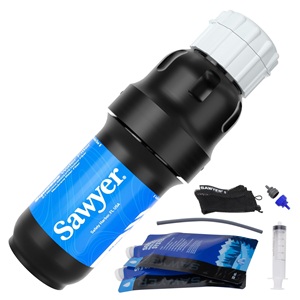
If I could hand one filter to a new backpacker and walk away confident, it would be the Sawyer Squeeze. It has been the default choice on long trails for years, and it earns that spot the boring way: it just keeps working. Thru-hikers have carried a single Squeeze across the Pacific Crest Trail, the Arizona Trail and the Colorado Trail.
You fill the included pouch (or screw the filter onto a standard 28mm bottle), squeeze and drink. Its hollow-fiber membrane is rated to 0.1 micron absolute, which physically blocks bacteria and protozoa, including Giardia and Cryptosporidium, plus microplastics.
The main weak point is the included pouches, which can develop pinholes over time. Pair the filter with a sturdier CNOC or HydraPak reservoir and the system becomes close to bulletproof. Flow slows as the membrane loads up, but a quick backflush restores it.
Pros
- Proven over thousands of trail miles
- Huge rated lifespan
- Affordable and widely available
- Works as a squeeze, inline or gravity setup
- Easy to backflush in the field
Cons
- Included pouches wear out, so budget for a better reservoir
- Flow slows if you skip cleaning
Specs
- Weight: about 3 oz (filter only)
- Pore size: 0.1 micron absolute
- Lifespan: rated to 100,000 gallons
- Removes viruses: No
- Price: about $30 to $45
Best for: backpackers, thru-hikers and anyone who wants one affordable, reliable all-rounder.
Verdict: The Squeeze leads the market because it nails the balance of weight, reliability and price. If you’re unsure what to buy, buy this.

 2. Katadyn BeFree: Best for Fast Water Flow
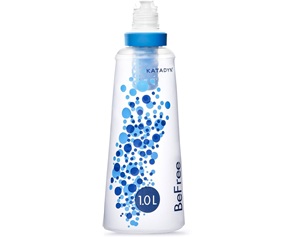
When you want water right now, the BeFree is hard to beat. Its open membrane lets you drink straight from the soft flask at up to 2 litres per minute, with no pumping and no waiting.
It’s also one of the easiest filters to maintain. There’s no backflushing. You simply shake or swish the EZ-Clean membrane in water and you’re back to full flow. At about 2.3 ounces, it disappears into a hip-belt pocket or running vest, which is why trail runners and fastpackers love it.
The trade-off is lifespan. The BeFree is rated to about 1,000 litres, far short of the Sawyer, so long-distance hikers will replace it more often. It also fits only 42mm wide-mouth bottles (HydraPak, CNOC Vecto), not a standard SmartWater bottle.
Pros
- Excellent flow rate
- Soft flask packs down tiny
- No-tools cleaning: just shake
- Effortless to use
Cons
- Shorter lifespan than the Sawyer
- Only fits 42mm wide-mouth bottles
- Flow drops as it ages
Specs
- Weight: about 2.3 oz
- Pore size: 0.1 micron
- Lifespan: about 1,000 L
- Flow rate: up to 2 L per minute
- Removes viruses: No
- Price: about $40 to $50
Best for: trail runners, fastpackers and minimalist hikers who prize speed and simplicity.
Verdict: If convenience matters more to you than maximum cartridge life, the BeFree is the most pleasant filter here to use day to day.
3. LifeStraw Personal Water Filter: Best Budget Choice
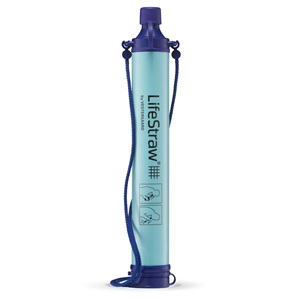
The LifeStraw made personal filtration mainstream, and it’s still the easiest filter to recommend to a casual hiker or to stash in an emergency kit. It’s a sealed straw you sip through directly from the source. There’s no pumping, no squeezing, no setup, and the price is hard to argue with.
It filters to 0.2 micron, removing bacteria, protozoa and microplastics, and a single unit is rated to roughly 4,000 litres. Stored dry, it has an unlimited shelf life, so it makes cheap insurance for a car, a go-bag or a day pack.
The limitation is versatility. In its basic form you drink directly from the source or from a scooped container. You can’t easily filter into a bottle or bladder for later, which makes it awkward as a primary thru-hiking filter. As a backup or budget starter, though, it’s excellent.
Pros
- Very affordable
- Dead simple, with nothing to break
- Excellent emergency and backup option
- Unlimited shelf life when dry
Cons
- Must drink from the source
- Awkward as a primary backpacking filter
- No virus removal
Specs
- Weight: about 1.6 to 2 oz
- Pore size: 0.2 micron
- Lifespan: about 4,000 L
- Removes viruses: No
- Price: about $15 to $20
Best for: casual hikers, emergency kits and budget-conscious campers.
Verdict: Not the filter I’d choose for a long thru-hike, but as the cheapest reliable safety net you can buy, the LifeStraw still earns its reputation.
 4. Platypus GravityWorks 4L: Best Gravity Water Filter
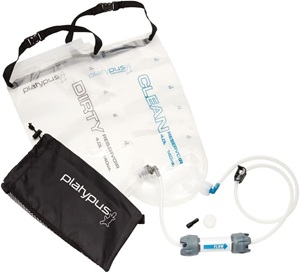
Once you’ve filtered for a group with a squeeze filter, you understand why gravity systems exist. With the GravityWorks, you fill the dirty reservoir, hang it from a branch and walk away. Gravity pushes water through the hollow-fiber cartridge into the clean bag while you set up camp. Four litres filters in about two and a half minutes, hands-free.
The colour-coded bags keep dirty and clean water separate, and backflushing is simple: hang the clean bag above the dirty one and let gravity reverse the flow. The cartridge is rated to 1,500 litres. Because the two 4L reservoirs double as camp water storage, the real weight penalty is smaller than the spec suggests.
It’s not the lightest option, and it costs more than a squeeze filter. For base camps, families and small groups, though, nothing makes camp hydration this painless.
Pros
- Filters large volumes with zero effort
- Hands-free operation
- Foolproof colour-coded, backflushable design
- Reservoirs double as water storage
Cons
- Heavier than squeeze systems
- More expensive
- Needs a hang point to flow well
Specs
- Weight: about 11.5 oz (full system)
- Pore size: 0.2 micron
- Lifespan: about 1,500 L
- Flow rate: about 1.75 L per minute
- Capacity: 4L per bag (8L total)
- Removes viruses: No
- Price: about $130 to $150
Best for: base campers, families and groups of two to four.
Verdict: The best gravity filter for group and camp use. If you’re tired of squeezing pouches for four thirsty people, this is the upgrade.
 5. MSR Guardian Gravity Purifier: Best for Groups and International Travel
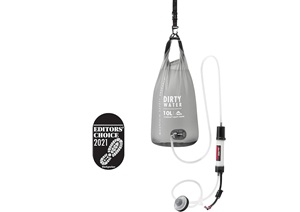
This is the one product here that crosses the line from filter to purifier, meaning it removes viruses as well as bacteria and protozoa. Originally designed for military use, the Guardian Gravity meets the NSF P248 testing standard. It pairs a 0.02 micron hollow-fiber membrane with an activated carbon stage that reduces chemicals, odd tastes and odours.
That makes it the system to reach for when you travel somewhere with viral risk, such as international trekking, regions with poor sanitation or any worst-case source. The 10-litre reservoir hangs and delivers clean water hands-free at about a litre every two minutes. Cleaning is just a matter of opening the purge hose, with no backflushing.
The downsides are predictable. At roughly 19 ounces and around $300, it’s the heaviest and most expensive option here by a wide margin. For a weekend in your local mountains it’s overkill. For an expedition where getting sick isn’t an option, it’s worth every gram and dollar.
Pros
- Removes viruses (rare in this category)
- Meets the NSF P248 military testing standard
- Carbon stage improves taste
- High-volume, hands-free operation for groups
Cons
- Expensive
- Heaviest option here
- Overkill for low-risk domestic trips
Specs
- Weight: about 19 oz (1 lb 3 oz)
- Pore size: 0.02 micron plus activated carbon
- Lifespan: about 3,000 L
- Flow rate: about 1 L every 2 minutes
- Capacity: 10L reservoir
- Removes viruses: Yes (99.99%)
- Price: about $300
Best for: international travel, expeditions and groups who need maximum protection.
Verdict: The premium price is justified if you need true virus protection or filter for a group in genuinely sketchy water. For everyone else, it’s more than the trip requires.
6. HydroBlu Versa Flow: Best Ultralight Value
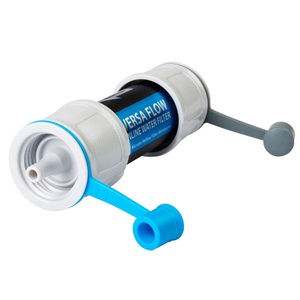
The Versa Flow is the underdog that quietly keeps up with filters costing far more. It uses 0.1 micron hollow-fiber tech, carries a 100,000-gallon rated lifespan and weighs just 2 ounces, yet it usually sells for under $30.
What I like most is the flexibility. The same filter works as a straw, a squeeze filter on a standard 28mm bottle, an inline filter on a hydration bladder or a gravity setup. For a backpacker building a light kit on a budget, that versatility is a real advantage, and regular backflushing keeps it going for years.
The honest caveats: build quality is good enough rather than premium, and brand recognition is lower, so replacement parts are harder to find than Sawyer’s. Some bottles, including SmartWater, can leak on its threads without an extra washer. None of that is a dealbreaker at this price.
Pros
- Excellent value, usually under $30
- Genuinely ultralight at 2 oz
- Very versatile: straw, squeeze, inline or gravity
- Long rated lifespan with backflushing
Cons
- Lower brand recognition
- Adequate rather than premium build quality
- Some bottles leak without a washer
Specs
- Weight: about 2 oz
- Pore size: 0.1 micron
- Lifespan: rated to 100,000 gallons
- Flow rate: about 1 gallon every 5 minutes
- Removes viruses: No
- Price: about $23 to $30
Best for: ultralight backpackers and gear tinkerers who want maximum capability per dollar.
Verdict: An underrated filter that delivers most of a Sawyer’s performance for less money and more versatility. The smart budget pick.
 7. Katadyn Hiker Pro: Best Pump Filter
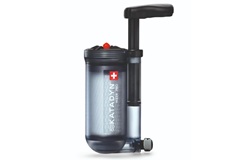
Pump filters have fallen out of fashion, but they still shine in one situation: shallow, awkward or murky sources. You drop the intake hose into a puddle, trickle or rock pool and pump clean water straight into your bottle or bladder. No scooping and no squeezing.
The Hiker Pro uses a 0.2 micron pleated glass-fiber cartridge with an activated carbon core, which removes bacteria and protozoa and improves taste. It produces about a litre per minute, and a cleanable filter protector extends cartridge life in silty water. The cartridge is rated to about 1,150 litres.
The trade-offs are effort and weight. At about 11 ounces it’s heavier than a squeeze filter, and pumping takes some muscle. If the pump gets hard to push, clean the filter rather than forcing it, because the housing can crack under strain.
Pros
- Pulls water from shallow or awkward sources
- Pumps straight into bottles and bladders
- Carbon core improves taste
- Field-cleanable filter protector
Cons
- Heavier than squeeze filters
- Pumping takes effort
- Housing can crack if forced when clogged
Specs
- Weight: about 11 oz
- Pore size: 0.2 micron (glass fiber with carbon core)
- Lifespan: about 1,150 L
- Flow rate: about 1 L per minute
- Removes viruses: No
- Price: about $80 to $90
Best for: hikers in dry country who rely on puddles and seeps, and anyone who wants filtered water without handling the source.
Verdict: The Hiker Pro is the pump to buy if your water sources are shallow, scummy or hard to reach.
 8. Aquamira Water Treatment Drops: Best Chemical Backup
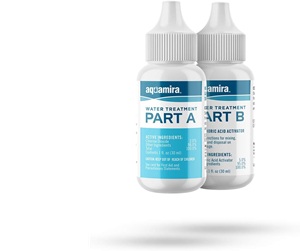
Aquamira isn’t a filter at all. It’s a two-part chlorine dioxide treatment, and it’s the lightest backup you can carry. You mix drops from the two bottles, let them activate, add them to your water and wait.
Unlike a standard filter, chlorine dioxide kills viruses as well as bacteria and protozoa, including Cryptosporidium. The catch is time. Bacteria and viruses are handled within about 15 minutes, Giardia takes about 30, and Cryptosporidium can take up to four hours, especially in cold or cloudy water. Unlike iodine, it leaves little taste and won’t discolour your water.
A kit weighs almost nothing and treats up to 30 gallons. I carry it alongside my filter on every long trip, because it covers you if the filter clogs, cracks or freezes, and it adds virus protection a standard filter can’t.
Pros
- Kills viruses, bacteria and protozoa
- Nearly weightless
- Little aftertaste compared to iodine
- Long shelf life
Cons
- Long wait for Cryptosporidium
- Doesn’t remove sediment
- Two-part mixing is fiddly with cold hands
Specs
- Weight: about 3 oz (two 1 oz bottles plus cap)
- Active ingredient: chlorine dioxide
- Capacity: up to 30 gallons per kit
- Wait time: about 15 minutes to 4 hours, depending on the threat
- Removes viruses: Yes
- Price: about $15
Best for: every hiker as a backup, and ultralight hikers who skip a filter on short trips.
Verdict: The best insurance policy in this guide. Carry it even if you own a great filter.
Backpacking Water Filter Comparison Table
| Product | Type | Weight | Pore Size | Lifespan | Removes Viruses | Best Use | Price |
|---|---|---|---|---|---|---|---|
| Sawyer Squeeze | Squeeze | 3 oz | 0.1 micron | 100,000 gal | No | All-round, thru-hiking | $30 to $45 |
| Katadyn BeFree | Squeeze flask | 2.3 oz | 0.1 micron | 1,000 L | No | Fast solo use | $40 to $50 |
| LifeStraw Personal | Straw | 1.6 oz | 0.2 micron | 4,000 L | No | Budget, emergency | $15 to $20 |
| Platypus GravityWorks 4L | Gravity | 11.5 oz | 0.2 micron | 1,500 L | No | Groups, camp | $130 to $150 |
| MSR Guardian Gravity | Gravity purifier | 19 oz | 0.02 micron | 3,000 L | Yes | Travel, expeditions | about $300 |
| HydroBlu Versa Flow | Squeeze, inline | 2 oz | 0.1 micron | 100,000 gal | No | Ultralight, value | $23 to $30 |
| Katadyn Hiker Pro | Pump | 11 oz | 0.2 micron | 1,150 L | No | Shallow sources | $80 to $90 |
| Aquamira Drops | Chemical | 3 oz | N/A | 30 gal | Yes | Backup | about $15 |
Prices are approximate and change often. Tap any link above for the current price.
Types of Backpacking Water Treatment
Each treatment method suits a different trip. Here’s how they compare:
- Squeeze filters (Sawyer, BeFree, Versa Flow): light, fast and cheap. The best default for solo hikers.
- Straw filters (LifeStraw): the simplest option, but you drink at the source.
- Gravity filters (GravityWorks, Guardian): hands-free and ideal for groups, though heavier.
- Pump filters (Hiker Pro): great for shallow or murky sources, but heavier and slower to use.
- Chemical treatment (Aquamira): nearly weightless and kills viruses, but requires waiting.
Water Filter vs Water Purifier: What’s the Difference?
This distinction trips up many buyers, and it matters for safety.
Water filters physically strain out bacteria and protozoa. These cause most backcountry illness in North America, Australia and other temperate regions. However, filters don’t remove viruses, because viruses are small enough to slip through a 0.1 micron membrane.
Water purifiers also neutralise viruses. They do it with a much finer membrane (like the Guardian’s 0.02 micron element), with chemicals like chlorine dioxide, or with UV light. You need purification when travelling somewhere with real viral risk, such as regions with poor sanitation or water likely contaminated by human waste.
The simple rule: for hiking and camping at home, a filter is plenty. For international travel to higher-risk areas, choose a purifier or add chemical treatment.
How to Choose the Best Backpacking Water Filter for You
Match it to your trip style
- Day hikes: a LifeStraw or HydroBlu Versa Flow is all you need.
- Solo weekend trips: the Sawyer Squeeze or Katadyn BeFree hits the sweet spot.
- Thru-hiking: the Sawyer Squeeze, for its huge lifespan and proven durability.
- Desert routes with poor sources: the Katadyn Hiker Pro, plus Aquamira as backup.
- Family or group camping: the Platypus GravityWorks handles volume with no effort.
- International adventures: the MSR Guardian, for true virus protection.
Think about group size
- Solo: a squeeze or straw filter is lightest and simplest.
- Couples: a squeeze filter works, but a small gravity system is more pleasant.
- Groups of three or more: a gravity system saves enormous time and effort.
Consider maintenance
Every hollow-fiber filter slows down as sediment builds up. What differs is how you fix it:
- Backflushing (Sawyer, HydroBlu, GravityWorks): quick, with a syringe or reverse flow.
- Shake to clean (Katadyn BeFree): the easiest of all.
- Purge valve (MSR Guardian): open the hose and you’re done.
- Scrub or swish (Hiker Pro): clean the filter protector in the field.
The golden rule: never let a filter freeze with water inside. Ice can rupture hollow fibers invisibly, and a damaged filter may no longer be safe. In cold weather, sleep with your filter in your sleeping bag.
Tips for Using Backpacking Water Filters Safely
- Collect the clearest water you can find. Pre-filtering silty water through a bandana greatly extends filter life.
- Don’t stir up sediment. Let it settle, then skim from the top.
- Protect filters from freezing. This is the most common way people unknowingly ruin a filter.
- Keep up with maintenance. Backflush or swish regularly to maintain flow.
- Carry a backup. A few purification tablets or Aquamira drops weigh almost nothing.
- Know your emergency options. The EPA’s guide to emergency disinfection of drinking water explains boiling and bleach methods if all else fails.
For more survival know-how, see our guides on how to purify salt water and building a DIY water filter. And if you’re still building your kit, our camping gear checklist covers everything else you’ll need.
Frequently Asked Questions
What is the best backpacking water filter overall?
The Sawyer Squeeze. It strikes the best balance of weight, reliability, lifespan and price, and it’s proven across thousands of trail miles.
Are backpacking water filters safe?
Yes. Quality filters rated to 0.1 or 0.2 micron remove 99.9999% of bacteria and 99.9% of protozoa. The key caveat is viruses: standard filters don’t remove them, so higher-risk water needs a purifier or chemical treatment.
Can water filters remove viruses?
Most can’t, because viruses are smaller than the 0.1 micron pores in a typical hollow-fiber filter. To remove viruses, use a purifier like the MSR Guardian, chlorine dioxide drops like Aquamira, or UV treatment.
How long do backpacking water filters last?
It varies by model. The Sawyer Squeeze and HydroBlu Versa Flow are rated to 100,000 gallons, while the Katadyn BeFree is rated to about 1,000 litres. Real-world life depends heavily on water quality and how often you clean the filter.
Is a LifeStraw good for backpacking?
It’s good as a backup or for day hikes and emergency kits. As a primary thru-hiking filter it’s limited, because you have to drink directly from the source.
Are pump filters still worth buying?
Yes, for specific conditions. A pump like the Katadyn Hiker Pro excels at pulling water from shallow puddles, seeps and murky pools where a squeeze bag is hard to fill.
Do I still need purification tablets or drops?
It’s smart to carry some. They weigh almost nothing, cover you if your filter clogs, breaks or freezes, and add virus protection a standard filter can’t provide.
Final Verdict: Which Backpacking Water Filter Should You Buy?
For the best all-round performer, the Sawyer Squeeze remains the top pick. It’s affordable, reliable and proven over more miles than any other filter here.
Choose the Katadyn BeFree for speed and effortless use, the HydroBlu Versa Flow for maximum capability on a tight budget, and the LifeStraw as a cheap emergency backup. Groups and families should look hard at the Platypus GravityWorks, while international travellers who need virus protection should invest in the MSR Guardian Gravity Purifier. If your sources are shallow and murky, the Katadyn Hiker Pro is the pump to get. Whatever you choose, pack Aquamira drops as backup.
A reliable filter is one of the smartest, cheapest investments you can make in your comfort and safety outdoors. Don’t learn about Giardia the hard way.
The information in this guide is for educational purposes. Always follow manufacturer instructions and use sound judgment about water sources in the field.

Daniel is a gear freak when it comes to hiking, climbing and camping. He went to REI Outdoor School to meet new people and learn best practices. Don’t even try to argue with him about the latest backpack or ice axe, he tried most of them. Daniel’s dream is to climb Mount Everest.
Katadyn gravity is the best filter I have ever had! It is easy to fill, easy to use, easy to pack. So easy to fill a water bottle quickly. Be careful filling the bag over a river, since it gets full and heavy fast. Also, I didn’t notice any odd tastes. I highly recommend!
Filtering 2 liters of water in 2 minutes is no mean feat – thanks to the Katadyn. It’s versatile and seamlessly connects to a hydration bladder or a shower. The price is also affordable, yet you get a top-notch product.
What would you recommend between the Platypus Gravity and the Sawyer Squeeze? Or even the Sawyer filtration system that you mentioned? I’m drawn to the Sawyer Squeeze because of the price – it comes in around half the price of the Platypus, I believe – but are there any other features that I should consider as an advantage over the Platypus (or vice versa)? I normally only use Platypus products as I’ve never been let down by them but I’ve heard great things about Sawyer as a brand. And obviously the price is nicer!
The filtration system of the Sawyer is exceptional. As I’ve said in my article, and quoting myself (LOL): “It removes 99.9999% of the bacteria and protozoa from your drinking water – making it completely safe to drink.”