

The best portable solar charger for most people is the BigBlue 3 28W, a lightweight, high-efficiency fold-out panel that reliably charges phones and power banks even in patchy sun. For the fastest USB-C charging go with the Anker SOLIX PS30, for an all-in-one battery-and-panel the Hiluckey 25,000mAh, for a pocket backup the BLAVOR, and for base camp or a power station the FlexSolar 40W. The single most important rule is to charge a power bank with your panel, not your phone directly.
Dead phone, no outlet, middle of nowhere. I’ve been there, and those three things together can turn a great trip into a genuinely stressful situation. A good portable solar charger is cheap insurance against it, and solar tech has come a long way. Panels are lighter, more efficient, and more weather-resistant than ever, and the best models now support USB-C Power Delivery, so in good sun they can charge your devices about as fast as a wall socket.
Below are my picks across five different use cases, a plain-English buying guide, and the one setup tip that makes solar charging actually work in the field.
Note: We get commissions for purchases made through links in this article, at no extra cost to you.
Best Portable Solar Chargers at a Glance
| Charger | Best for | Output | Battery included? | Key feature |
|---|---|---|---|---|
| BigBlue 3 28W | Best overall | 28W (2x USB-A, 1x USB-C) | No | High efficiency, digital ammeter |
| Anker SOLIX PS30 | Fastest charging | 30W, USB-C Power Delivery | No | Full USB-C PD speed |
| BLAVOR Solar Power Bank | Compact backup | 10W panel, 10,000mAh | Yes | Pocketable, Qi wireless, IP64 |
| Hiluckey 25,000mAh | Battery included | 4 panels, 25,000mAh | Yes | Big battery, all-in-one |
| FlexSolar 40W | Base camp / power stations | 40W, USB-C + USB-A + DC | No | DC output for power stations |
Best Overall: BigBlue 3 28W Solar Charger
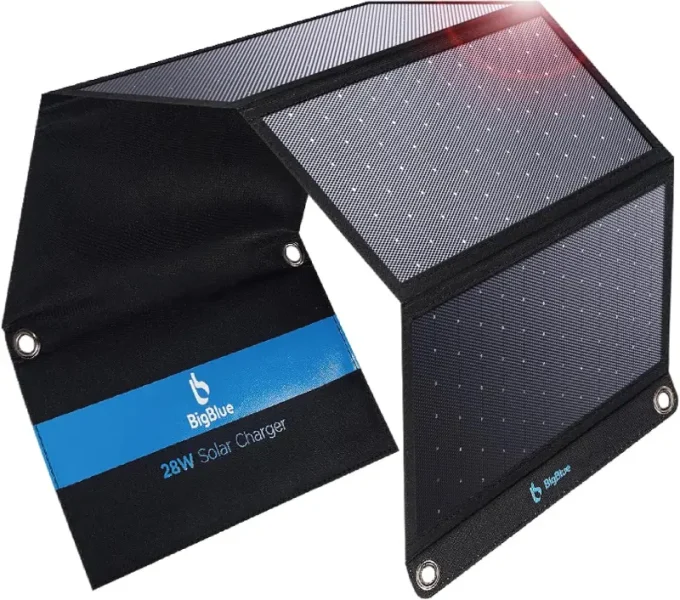
If I could point you to just one solar charger, this is it. The BigBlue 3 28W has long been a favorite in independent outdoor-gear testing, and it earned that reputation through real-world performance rather than marketing.
The panel unfolds into four sections and has three USB ports, two USB-A and one USB-C. That USB-C port matters, since virtually every modern phone, tablet, and power bank now charges over USB-C.
The panel uses monocrystalline SunPower cells with a solar efficiency rating around 24%, which sits at the top end of what portable panels achieve. A built-in digital ammeter shows your real-time output, so you can angle the panel toward the sun and watch the current climb, which is genuinely useful.
Where it beats cheaper options is on days with intermittent cloud. Many budget panels simply cut out when a cloud passes, while the BigBlue 3 keeps a meaningful charge going in indirect light. That is often the difference between reaching camp with a full power bank and a half-empty one.
The trade-off is that it has no built-in battery, so you pair it with a separate power bank. For most backpackers I’d match it with a compact 10,000mAh power bank for a complete off-grid charging system.
Best use: Backpacking, hiking, bike touring, and anywhere you need reliable charging without much weight.

Best for Fast Charging: Anker SOLIX PS30 30W Foldable Solar Panel
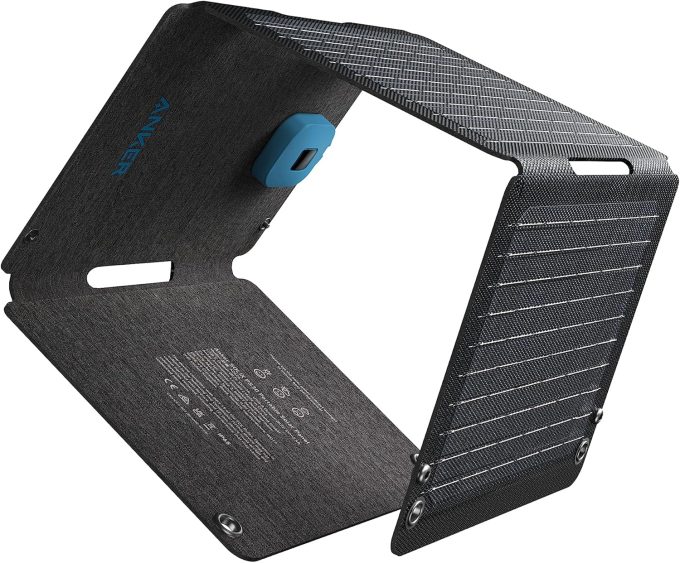
Anker has made some of the most trusted charging gear on the market for years, and the SOLIX PS30 is among its strongest portable panels. At 30 watts it’s slightly more powerful than the BigBlue 3, and it supports USB-C Power Delivery, which pushes a faster, smarter charge to compatible devices and power banks.
Power Delivery is worth understanding, because it changes what’s possible. A standard USB-A port tops out around 12 watts. A USB-C PD port on a panel like this can deliver up to 30 watts, which cuts charging times dramatically for compatible gear. Charging a 10,000mAh power bank over standard USB-A can take six hours or more, while a USB-C PD panel can cut that to roughly two hours in good sun. If you’re charging a modern iPhone, a Samsung Galaxy flagship, or a quality USB-C power bank, PD is the protocol that makes it fast.
The panel folds flat, includes two carabiners for clipping to a pack, and comes with Anker’s 18-month warranty. In direct sun it charges at up to 3 amps and holds up reasonably well in cloud. It’s a touch heavier than the BigBlue 3, which matters to gram-counters, but for most hikers and campers the speed is worth it.
Best use: Hikers, campers, and travelers who want the fastest charging and use USB-C devices.
Need more trip essentials? See my guide to the best water purification tablets that really work.
Best Compact Solar Power Bank: BLAVOR Solar Power Bank 10W
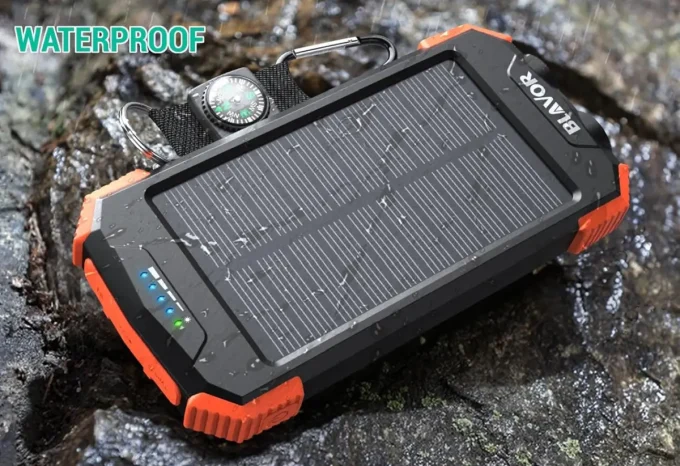
Not everyone needs a fold-out panel. If you want something that fits in a jacket pocket and gives you a solar backup for emergencies without any bulk, the BLAVOR is the one I recommend. It combines a 10,000mAh power bank with a built-in solar panel, wireless Qi charging, and an LED flashlight.
I want to be honest about what the small panel on a unit like this can do. It will not fully recharge the internal battery in a day of hiking. The solar panel here is an emergency top-up, not a primary charging source, and that’s true of every pocket solar power bank, not just this one.
What makes the BLAVOR worth it is the combination: wireless charging for phones that support it, USB-C input and output, a genuinely bright flashlight, and an IP64 water- and dust-resistant, shockproof build, all at a price that makes it easy to toss in a bag as backup. For day hikers, travelers, and anyone who wants a capable power bank that also works as a solar backup in a pinch, it’s excellent value. Just don’t plan a week-long backcountry trip around its solar rate.
Best use: Day hikes, travel, emergencies, and as a secondary backup on longer trips.
Best for Backpackers Who Want a Battery Included: Hiluckey Solar Charger 25000mAh
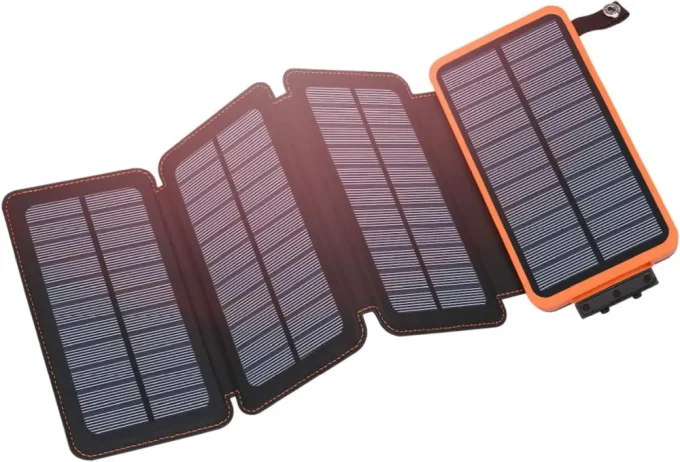
Where the BLAVOR trades capacity for compactness, the Hiluckey goes the other way, with a high-capacity 25,000mAh power bank built into a foldable four-panel solar charger. That battery is enough to fully charge the average smartphone roughly six to eight times, so it can realistically keep a solo hiker’s phone going through a four or five-day trip without a wall outlet, as long as you get reasonable sun.
The design is clever. The four panels fold out to capture a decent surface area, and the unit has one USB-C port and two USB-A ports, so you can charge three devices at once. The USB-C port handles both input and output, so you can top it up from a wall charger or car outlet before you leave, then let the panels maintain the charge on the trail. That hybrid approach is how I’d use any combo unit: charge it fully from the wall the night before, and let the sun handle the rest.
At its price, this is one of the best value propositions in the category. The trade-off versus a dedicated fold-out panel is that the built-in cells are smaller and slower, so in direct sun you’ll typically see only a couple of watts of solar input rather than the 25 to 28 watts the BigBlue or Anker deliver. For multi-day trips where weight, simplicity, and all-in-one convenience matter more than raw speed, it earns its place.
Best use: Multi-day backpacking and camping where you want one all-in-one unit instead of managing a separate panel and battery.
Your gadgets need direct sun, but you don’t. Learn more about the UV index and protect yourself with one of these top boonie hats I swear by.
Best for Base Camping and High-Output Charging: FlexSolar 40W Foldable Solar Panel
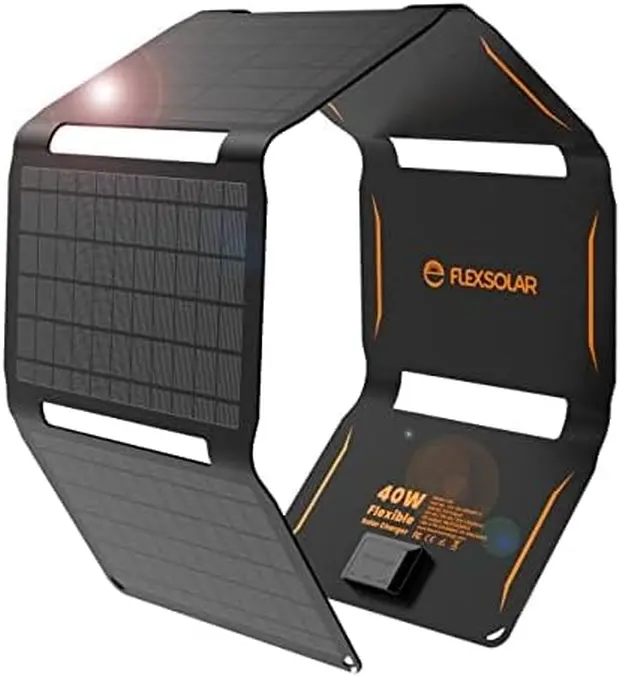
If you’re car camping, running a base camp, or on a rafting or bikepacking trip with several devices and a portable power station to keep topped up, the FlexSolar 40W is my pick. It’s the highest-output panel here at 40 watts, and it stands out by including a DC output alongside USB-C and USB-A, which lets it charge larger portable power stations directly, not just phones and tablets.
In independent testing it has charged mid-size portable power stations quickly via that DC output, which is exactly what matters when you’re keeping a base camp powered. And unlike some high-wattage panels that are powerful but fiddly, the FlexSolar opens cleanly with no Velcro, magnets, or clasps to wrestle. You fold it out, angle it, and plug in. That simplicity is underrated in the field. The USB-C port also supports Power Delivery, so you get fast charging for modern devices even without running through a power station.
Folded down it’s roughly the size of a hardcover book. It’s not an ultralight backpacking option, but for base camp or group use it’s the most capable, practical panel I can recommend at this price.
Best use: Base camping, car camping, rafting, group trips, and charging a portable power station efficiently.
How to Choose a Portable Solar Charger
A few factors decide whether a solar charger actually helps you or just adds weight.
Wattage (output). Higher wattage means faster charging. Roughly, 10 to 21 watts suits a single phone and light use, 28 to 30 watts comfortably keeps a phone and a power bank topped up, and 40 watts and up is for power stations and group charging. Remember the rated wattage is a best-case figure in perfect sun.
USB-C Power Delivery. If your devices are modern, prioritize a panel with a USB-C PD port. It charges compatible phones and power banks far faster than USB-A, which tops out around 12 watts.
Panel only vs. panel plus battery. A bare panel is lighter and more efficient but needs a separate power bank. An all-in-one with a built-in battery is simpler but charges more slowly from its smaller cells. More on this below.
Weight and packed size. For backpacking, every ounce counts, so lean toward an efficient fold-out panel. For car or base camp, weight barely matters and you can run a bigger panel.
Efficiency and cloudy-weather performance. Monocrystalline cells (often SunPower) are the most efficient, around 22 to 25%, and better panels keep charging in indirect light instead of cutting out when a cloud passes.
Durability. Look for weather-resistant fabric and an IP rating if you expect rain, dust, or rough handling.
Panel-Only vs. Panel Plus Power Bank: The One Rule That Matters
Before you buy, know this: don’t plug your phone directly into a solar panel if you can avoid it. Solar panels produce variable output as the light changes from moment to moment. A cloud passes or a shadow falls and the current drops, and your phone’s charging circuit doesn’t handle that well. Many phones stop and restart the charge cycle repeatedly as the light fluctuates, which is inefficient and, over time, harder on the battery.
The smarter approach is to use the panel to charge a separate power bank through the day. The power bank absorbs the variable solar current steadily, then delivers a clean, consistent charge to your phone or tablet whenever you want it, including after dark. Most of the panel-only chargers above include carabiner points so you can clip the panel to your pack and charge a power bank passively while you hike. That’s the setup I use and recommend.
Some products combine the panel and power bank in one unit, trading a bit of charging efficiency for convenience and compactness. Both approaches work, so pick the one that fits how you travel.
Frequently Asked Questions
Do portable solar chargers actually work?
Yes, when you set your expectations and setup correctly. A good 28 to 30 watt fold-out panel in direct sun will charge a power bank or phone at close to wall-socket speed. The keys are adequate sunlight, a quality monocrystalline panel, and charging a power bank rather than your phone directly.
How many watts do I need in a solar charger?
For keeping a phone and a power bank charged on a trip, 28 to 30 watts is the sweet spot. Smaller 10 to 21 watt panels suit a single phone and emergency use, while 40 watts and up is for power stations and group charging.
Should I charge my phone directly from a solar panel?
Ideally no. Variable sunlight makes the output fluctuate, which causes phones to stop and restart charging and can stress the battery. Charge a power bank from the panel, then charge your phone from the power bank for a steady, clean charge.
What is USB-C Power Delivery and why does it matter?
Power Delivery (PD) is a fast-charging standard. A USB-C PD port can deliver up to around 30 watts, versus about 12 watts for standard USB-A, which dramatically cuts charging times for compatible phones and power banks.
Will a solar charger work on cloudy days?
It will charge more slowly. Better panels with high-efficiency monocrystalline cells keep producing a useful charge in overcast or indirect light, while cheaper panels often cut out. Expect significantly reduced output and plan for more charging time.
Are solar power banks with built-in panels any good?
They’re great as a backup, but the small built-in panel can’t fully recharge the internal battery in a day. Use them as an emergency top-up, and charge the battery from the wall before your trip for best results.
Conclusion
Portable solar power isn’t the cheapest way to keep devices charged, but it can be exactly the solution you need when you’re far from an outlet. The right pick depends on your trip: the BigBlue 3 28W is the best all-rounder, the Anker SOLIX PS30 is fastest, the BLAVOR is the pocket backup, the Hiluckey is the all-in-one, and the FlexSolar 40W rules base camp.
Pay more attention to the specs than the looks, charge a power bank rather than your phone directly, and be wary of cheap imposters with inflated wattage claims, since the solar market is full of them. Do your research and the sun will keep you powered wherever you roam.
For another trip essential, see our guide to the best survival lighter.
What’s your go-to charging setup for off-grid trips? Share your experience in the comments below.



I took the Instapark Mercury 10M Solar Panel Portabl Solar Charger camping, with the intention of trying it out before deploying back to Afghanistan. This little guy is a beast. With the included battery we were able to play music on the iPhone all weekend long without any issues. We could even throw a second phone in there to charge when people needed it. I expected more of a trickle charge, while this thing will charge a phone to 74% in 1 hour. It won’t charge like a wall outlet, but I never expected it too. I am very impressed with this item, and have already ordered a second one for my fiance.
Good to know Andrew! For longer trips I also recommend the Powered Apollo3 8000mAh Power Bank Solar Charger. You can charge 2 of your gadgets and still have enough power to charge other devices. I also find that to “conserve” on the solar charger’s power, I usually charge my gadget and after the battery is “full” that’s the time I use it. If you continue to use your gadget while it is still connected on the power bank, you’ll replete your solar charger in no time.
I have a Power Monkey extreme. It is pricey (bought one for $140) but it is really worth it. I found out that I could get 20% charge on an iPhone 6 plus based on a few hours in the morning. It would have been fine for a long trip if it had not rained. The downside of it is, it’s actually heavy. But if you’re camping with a lot of people, it can really charge your things and is very durable. But for ordinary camping, I would suggest starting with Goal Zero Nomad 7 Solar Panel because it is really lightweight (along with 6 inches 5-in-1 USB adapter to charge things).
Choose the one that’s right for you – that includes making sure you can carry it without straining yourself. The Power Monkey extreme is an excellent product and so is the Goal Zero Nomad 7. Also, take a look at the capacity (mAh) and see if that’s enough for your gadgets. A higher mAh is always preferable especially for long trips.