

Dead phone, no outlet, middle of nowhere. I’ve been there, and I can tell you from experience that those three things together are enough to turn a great outdoor adventure into a genuinely stressful situation. That is why we all need the best solar chargers to keep our mobile devices fully charged!
The good news is that solar charging technology has come a very long way. The panels are lighter, more efficient, and more weather-resistant than they’ve ever been, and the best models now support USB-C Power Delivery, which means they can charge your devices as quickly as a wall socket can in good sunlight.
Solar Chargers Recommended for Light Packers
We have also done our research and we have got our own thoughts and reviews on the different solar chargers right here to help you decide which solar chargers you should purchase. Consider the different types of solar chargers here and see if it fits your preferences.
Note: We get commissions for purchases made through links in this article
Best Overall: BigBlue 3 28W Solar Charger
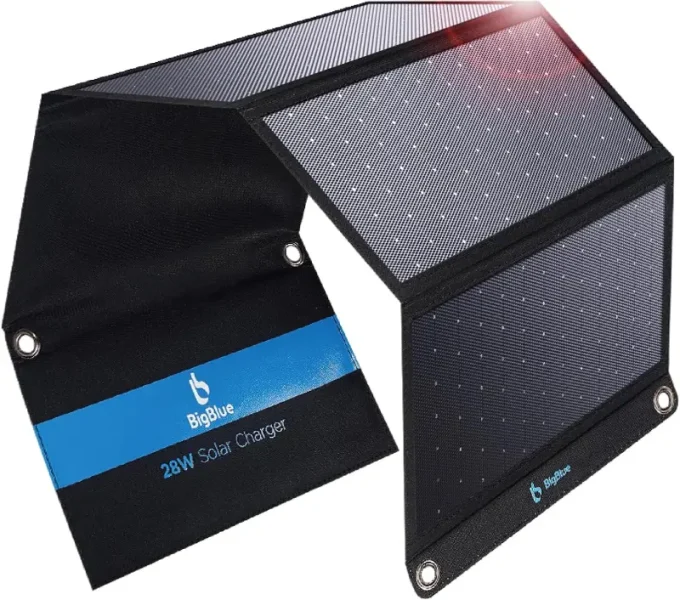
If I could only point you to one solar charger, thisis it. The BigBlue 3 28W has consistently topped independent field testing across multiple serious outdoor gear publications, and it earned that position the hard way: through actual performance data.
The panel unfolds into four sections and features three USB ports: two USB-A and one USB-C. That USB-C port matters a lot, since virtually every modern phone, tablet, and power bank now charges via USB-C.
The panel uses monocrystalline SunPower cells with a solar efficiency rating of around 24%, which sits at the top end of what portable panels achieve. A built-in digital ammeter displays your real-time output, so you can see exactly how much power the panel is generating and nudge its angle toward the sun accordingly. That small feature is truly useful.
Where it stands apart from cheaper options is on days with intermittent cloud cover. Many budget panels simply shut off when a cloud passes.
The BigBlue 3 maintains a meaningful charge output even in indirect sunlight, which is often the difference between arriving at camp with a full power bank and arriving with a half-empty one.
The trade-off is that it has no integrated battery, so you’ll need to pair it with a separate power bank. For most backpackers, I’d pair it with an Anker PowerCore 10000 or similar compact power bank for a complete off-grid charging system.
Best use: Backpacking, hiking, bike touring, and anywhere you need reliable charging power without carrying too much weight.
Click here to check it at Amazon
Best for Fast Charging: Anker SOLIX PS30 30W Foldable Solar Panel
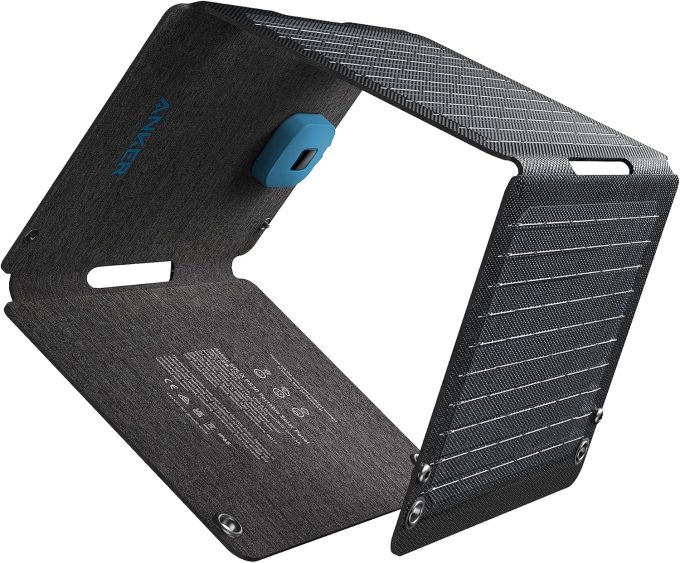
Anker has been making some of the most trusted charging accessories on the market for years, and the SOLIX PS30 is their strongest portable solar panel to date.
At 30 watts it’s slightly more powerful than the BigBlue 3, and it supports USB-C Power Delivery, which means it can push a faster, smarter charge to compatible devices and power banks.
Power Delivery is worth understanding because it changes what’s possible. A standard USB-A port tops out at around 12 watts of charging output.
A USB-C Power Delivery port can deliver up to 30 watts, which cuts charging times dramatically for compatible devices. If you’re charging a modern iPhone, a Samsung Galaxy flagship, or a quality USB-C power bank, Power Delivery is the protocol that makes it happen at speed.
Charging a 10,000mAh power bank with a standard USB-A connection can take six hours or more. With a USB-C PD panel like the SOLIX PS30, you can cut that to under two hours in good sunlight.
The panel folds flat, includes two carabiners for easy attachment to your pack, and comes with Anker’s 18-month warranty.
In direct sunlight it charges at up to 3 amps, and it performs well in cloudy conditions in independent testing. It is slightly heavier than the BigBlue 3, which matters if you’re a gram-counter, but for most hikers and campers the speed advantage is worth it.
Best use: Hikers, campers, and travelers who want the fastest possible charging and who use USB-C devices.
Click here to check it at Amazon.
Need more great products? Check out my recommendations here: Best Water Purification Tablets that Really Work
Best Compact Solar Power Bank: BLAVOR Solar Power Bank 10W
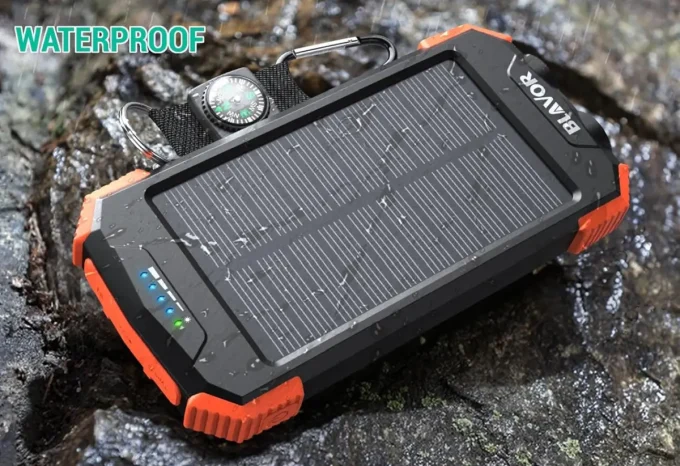
Not everyone needs a fold-out panel. If you want something that fits in a jacket pocket and gives you a solar backup option for emergencies without any of the bulk, the BLAVOR is the one I recommend.
It combines a 10,000mAh power bank with a built-in solar panel, wireless Qi charging, and a built-in LED flashlight.
I want to be honest with you about what the solar panel on a unit like this can realistically do: it’s not going to fully recharge its internal battery in a single day of hiking.
The solar panel here is useful as an emergency top-up, not as a primary charging source.
What makes the BLAVOR worth recommending is the combination: wireless charging for phones that support it, USB-C input and output, a flashlight that’s actually bright, and an IP64 waterproof and shockproof build quality, all at a price that makes it easy to justify throwing in your bag as a backup.
For day hikers, travelers, and anyone who wants a capable power bank that happens to also work as a solar backup in a pinch, this is excellent value. Just don’t plan your week-long backcountry trip around its solar charging rate.
Best use: Day hikes, travel, emergencies, and as a secondary backup device on longer trips.
Click here to check at Amazon.
Best for Backpackers Who Want a Battery Included: Hiluckey Solar Charger 25000mAh
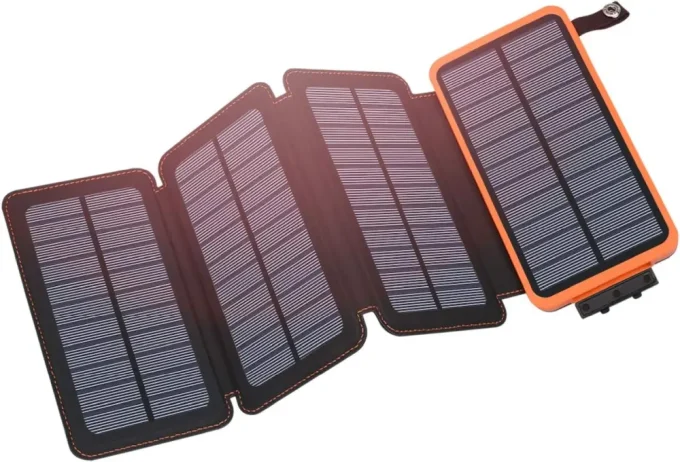
Where the BLAVOR trades capacity for compactness, the Hiluckey goes in the opposite direction: a high-capacity 25,000mAh power bank built into a foldable four-panel solar charger.
That battery capacity is enough to fully charge the average smartphone six to eight times, which means this unit can realistically power a solo hiker’s phone through a four or five-day trip without ever needing a wall outlet, as long as you get reasonable sun during the day.
The design is clever. The four solar panels fold out to capture a decent amount of surface area, and the unit has one USB-C port and two USB-A ports so you can charge three devices at once.
The USB-C port supports input and output, so you can also top it up from a wall charger or car outlet before you leave, then let the solar panels maintain the charge while you’re out.
That hybrid approach is actually how I’d suggest most people use a combo unit like this: charge it fully from the wall the night before you leave, and let the sun handle the rest.
At its price point, this is one of the best value propositions in the entire solar charger category. The trade-off compared to a dedicated fold-out panel is that the solar cells are smaller and the charging rate per panel is lower, so in direct sunlight you’ll typically see 1-2 watts of solar input rather than the 25-28 watts the BigBlue or Anker SOLIX can deliver.
But for multi-day backpacking trips where weight, simplicity, and all-in-one convenience matter more than raw speed, it earns its place in the pack.
Best use: Multi-day backpacking and camping trips where you want an all-in-one unit and don’t want to manage a separate panel and power bank.
Click here to check it at Amazon
Even though your gadget requires direct sunlight, you don’t! Learn more about the UV index here, and protect yourself with one of these top boonie hats I swear by.
Best for Base Camping and High-Output Charging: FlexSolar 40W Foldable Solar Panel
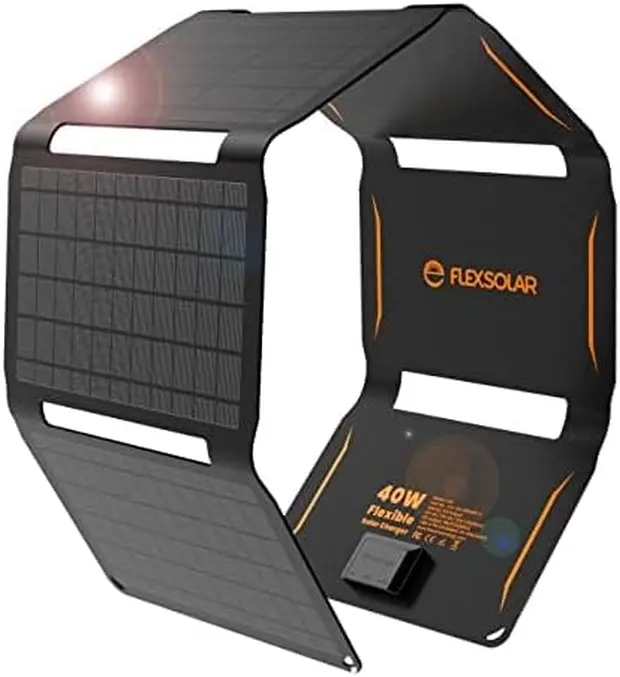
If you’re car camping, setting up a base camp, or running a rafting or bikepacking trip where you have multiple devices and a portable power station to keep charged, the FlexSolar 40W is the panel I recommend.
It’s the highest-output panel in this list at 40 watts, and it stands out because it includes a DC output in addition to USB-C and USB-A ports, which means it can charge larger portable power stations directly, not just phones and tablets.
In independent testing, the DC output on this panel charged a 240-watt-hour portable power station faster than any other comparable panel tested. That’s the kind of result that matters when you’re trying to keep a proper base camp powered.
And unlike some higher-wattage panels that are impressively powerful but a nightmare to set up, the FlexSolar opens cleanly with no velcro tabs, magnets, or clasps to wrestle with. You fold it out, angle it at the sun, and plug in. That simplicity in the field is underrated.
The USB-C port also supports Power Delivery, which ties back to what I mentioned earlier in the Anker SOLIX section: PD means faster charging for all your modern devices even when you’re not running it through a power station.
Six panels sound like a lot, but folded down this panel is roughly the size of a hardcover book. It’s not an ultralight backpacking option, but for the base camp or group camping scenario it’s the most capable and practical panel I can recommend at this price.
Best use: Base camping, car camping, rafting trips, group use, and anyone who needs to charge a portable power station efficiently.
Panel-Only vs. Panel + Power Bank
Before you get your favorite product and try it, here’s one thing to know: don’t plug your phone directly into a solar panel if you can avoid it.
Here’s why: solar panels produce variable output depending on how much sunlight they’re receiving from moment to moment.
A cloud passes, a shadow falls across the panel, and the current drops. Your phone’s charging circuitry doesn’t respond well to that kind of inconsistent input. Many devices will stop and restart the charging cycle repeatedly as the light changes, which is inefficient at best and hard on the battery over time.
The smarter approach is to use your solar panel to charge a separate power bank throughout the day. The power bank absorbs the variable solar current steadily, then delivers a clean, consistent charge to your phone or tablet whenever you need it, including at night.
Most of the panel-only chargers I recommend above include carabiner attachment points so you can clip the panel to your backpack and charge a power bank passively while you hike. That’s the setup I use, and it’s the one I recommend.
Some products in my list combine the panel and power bank in a single unit, which trades a bit of charging efficiency for convenience and compactness. Both approaches have their place, just make sure to pick the best for you.
Also read: Best Survival Lighter
Conclusion
Solar power from a portable panel is generally expensive but it can be the solution you need for your power-hungry devices during your outdoor trips and adventures. We hope our reviews provide you with the extra help you need to choose the solar panel chargers for you – no matter if you’re dry camping or whatnot.
The solar market is vast and growing, so it is best to pay more attention to the details than the looks before purchasing. Here’s our last buying tip: watch out for imposters in the realm of solar chargers and make sure you do your own research before purchasing solar panel chargers online!
What are your thoughts on this? We’d like to know what you think, so share your thoughts with us today!

Mark Foster loves to push his limits when it comes to survival in the wilderness. He might go for a 30-days adventure without any food or equipment except for a survival kit and a knife. We should mention that his survival kit has 122 items in it, so he know what he is doing. Mark is working on his book to share with the world all his experience gained during those brave adventures.
I took the Instapark Mercury 10M Solar Panel Portabl Solar Charger camping, with the intention of trying it out before deploying back to Afghanistan. This little guy is a beast. With the included battery we were able to play music on the iPhone all weekend long without any issues. We could even throw a second phone in there to charge when people needed it. I expected more of a trickle charge, while this thing will charge a phone to 74% in 1 hour. It won’t charge like a wall outlet, but I never expected it too. I am very impressed with this item, and have already ordered a second one for my fiance.
Good to know Andrew! For longer trips I also recommend the Powered Apollo3 8000mAh Power Bank Solar Charger. You can charge 2 of your gadgets and still have enough power to charge other devices. I also find that to “conserve” on the solar charger’s power, I usually charge my gadget and after the battery is “full” that’s the time I use it. If you continue to use your gadget while it is still connected on the power bank, you’ll replete your solar charger in no time.
I have a Power Monkey extreme. It is pricey (bought one for $140) but it is really worth it. I found out that I could get 20% charge on an iPhone 6 plus based on a few hours in the morning. It would have been fine for a long trip if it had not rained. The downside of it is, it’s actually heavy. But if you’re camping with a lot of people, it can really charge your things and is very durable. But for ordinary camping, I would suggest starting with Goal Zero Nomad 7 Solar Panel because it is really lightweight (along with 6 inches 5-in-1 USB adapter to charge things).
Choose the one that’s right for you – that includes making sure you can carry it without straining yourself. The Power Monkey extreme is an excellent product and so is the Goal Zero Nomad 7. Also, take a look at the capacity (mAh) and see if that’s enough for your gadgets. A higher mAh is always preferable especially for long trips.